


A regional insurer in Manchester receives 4,000 claims a week.
For years, three staff members read each one, checked the policy number against a database, flagged anything unusual, and routed the file to an adjuster.
In early 2026, the firm replaced that first pass with a piece of software.
The software reads the claim, pulls the matching policy, queries the fraud-scoring tool, drafts a summary, and sends only the borderline cases to a human. It runs overnight without instruction.
That software is an AI agent.

AI agent defined
An AI agent is a software system that pursues a goal by taking its own actions. It reads information, reasons about what to do, calls tools to do it, and repeats the cycle until the job is done.
A standard chatbot answers one question and stops, but an agent keeps going: it plans, acts, checks the result, and decides the next move.
The engine behind the reasoning is a large language model. The model reads the situation and chooses an action.
The actions come from tools: a web search, a database query, a code script, an email send.
The agent strings these together without a human pressing a button at each step.
How an AI agent differs from a chatbot
| Feature | Chatbot | AI agent |
| Pattern | One question, one answer | Goal, then a loop of actions |
| Tools | None or few | Search, code, APIs, files |
| Memory | The current chat | Short-term plus stored context |
| Human role | Prompts every turn | Reviews outcomes, sets guardrails |
How an AI agent works
The cycle has four parts.
- The agent reads its input: a request, a file, a data feed.
- It reasons, breaking the goal into smaller steps.
- It acts by calling a tool and reading what comes back.
- It judges the result and decides whether to continue.
The loop runs until the goal is met or a limit stops it.
A system prompt sets the rules. It tells the agent what it can do, which tools it may call, and when to hand control to a person.
Most production agents run inside an orchestration layer such as n8n, LangChain, or CrewAI, which manages the loop and connects the tools.
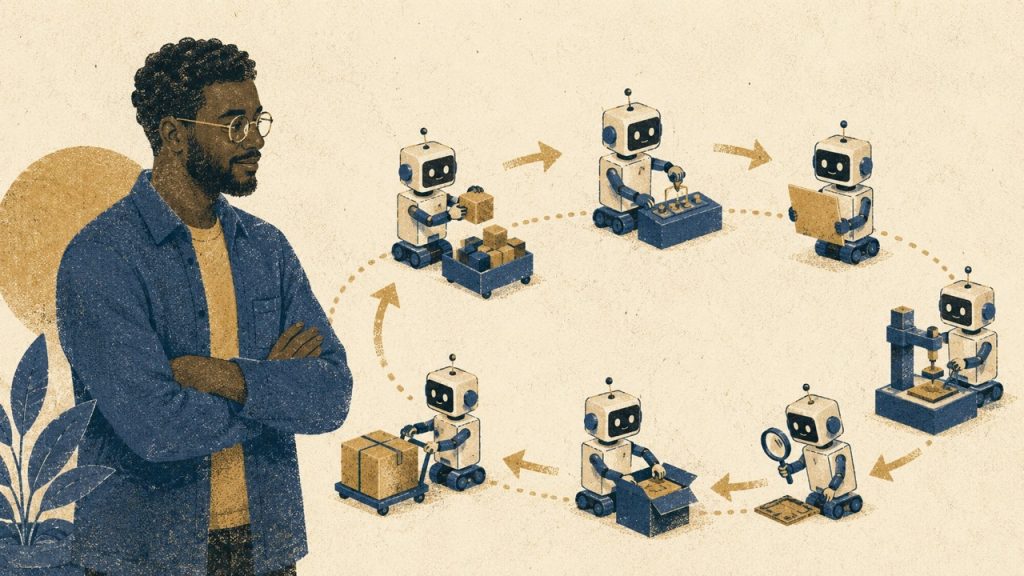
Three examples of AI agents
Consumer research: Perplexity reads a question, searches the web, reads the pages, and writes an answer with citations. The human asks once. The agent does the rest.
Software development: GitHub Copilot can read a coding task, plan the change, write the code, run the tests, and report what failed. A developer reviews the output before it ships.
Business operations: A custom n8n agent can monitor an inbox, read each message, classify it, draft a reply, and file the record in Google Drive. The team checks the queue once a day.
Each example follows the same shape: a goal, a set of tools, and a loop. What changes is the level of human oversight, which rises with the cost of a mistake.
How fast AI agent adoption is moving
McKinsey reports that 23% of organisations were scaling an agentic AI system in at least one business function by mid-2025, and another 39% had begun experimenting with agents.
Most of those scaling agents run them in only one or two functions, which tells you most of the change is still ahead.
The technology carries financial, governance, and security risks. Gartner expects more than 40% of agentic AI projects to be canceled by the end of 2027, citing rising costs, unclear value, and weak controls.
An agent can call the wrong tool, misread a result, or run a long loop that burns through a token budget.
When to use an AI agent
The dividing line is decision-making.
An agent fits a task with several steps, conditional choices, and a need to pull from live tools.
It doesn’t fit a single question with a fixed answer, or a process where every output needs human sign-off.
For a rule-based job that never changes, a plain workflow does the work for less money and less risk.