


TLDR: The core pattern this research surfaces is that the US CAIO market is less about a fixed job title and more about a senior AI transformation profile. The strongest version is someone who can speak to executives, prioritise business use cases, build or guide technical platforms, manage risk, lead adoption, and prove value in production. The title will vary, but the mandate stays the same.
The title “Chief AI Officer” is everywhere, but the role it describes is still being invented.
To understand what’s actually being asked for, I pulled and parsed 67 US LinkedIn listings scraped from an export covering “chief AI officer” and adjacent senior AI roles.
The sample included 34 listings with salary data, a median applicant count of 134 per listing, and representations from financial services, consulting, software, technology, insurance, healthcare, and consumer services.
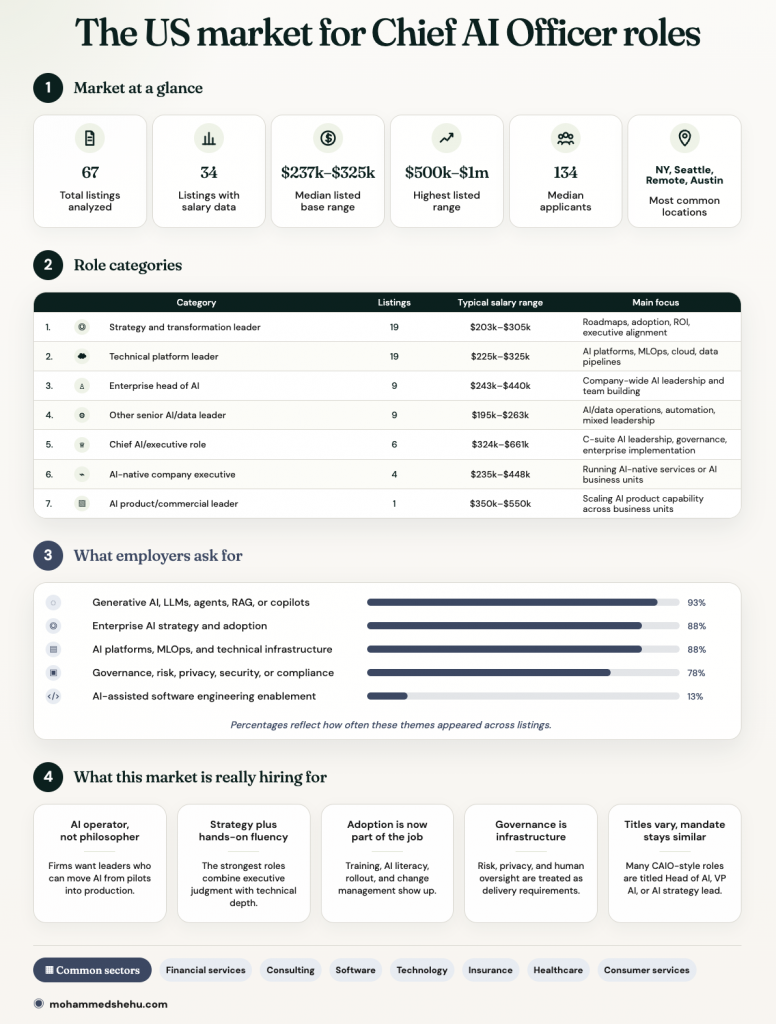
Here’s what the data shows, and what it means if you’re hiring for, or into, one of these roles.
Chief AI officer job description template
Copy, edit, and post. Replace bracketed fields with your specifics.
Job title: Chief AI Officer / Head of AI / VP, AI Strategy (use whichever fits your org)
Location: [Location / Remote / Hybrid]
About the role
We’re hiring a [Chief AI Officer / Head of AI] to define and drive our enterprise AI strategy, move AI initiatives from pilot into production, and build the governance frameworks that let us scale responsibly. This role reports to [CEO / CTO / Board] and has enterprise-wide scope.
You’ll work across [functions], partnering with business leaders, data and engineering teams, and risk and compliance stakeholders to turn AI capability into measurable business outcomes.
What you’ll own
- Enterprise AI strategy and multi-year roadmap, aligned to business objectives and prioritised by ROI
- End-to-end lifecycle of AI initiatives, from use-case identification through production deployment and continuous improvement
- AI governance framework, including model risk management, responsible AI standards, data privacy controls, and regulatory alignment
- Enterprise AI adoption: training, AI literacy programmes, change management, and internal enablement
- Technical platform direction, in partnership with engineering, covering LLMs, agentic systems, MLOps, RAG pipelines, and data infrastructure
- Executive and board-level reporting on AI investment, outcomes, and risk
What we’re looking for
- [10–15]+ years in technology, data, or strategy roles, with [5]+ years in senior AI or digital transformation leadership
- Demonstrated track record of moving AI from pilots into production at enterprise scale, with measurable business outcomes
- Hands-on fluency with generative AI, LLMs, agentic systems, RAG, MLOps, and enterprise data platforms
- Experience designing and operating AI governance frameworks in a regulated or compliance-sensitive environment
- Strong executive presence: able to advise the C-suite and board, influence without positional authority, and communicate complex AI concepts clearly to non-technical audiences
- Background in [financial services / healthcare / technology / consulting] preferred but not required
Preferred
- Experience with enterprise AI platforms (Azure OpenAI, AWS Bedrock, Vertex AI) and MLOps tooling
- Demonstrated ability to build and lead high-performing, cross-functional AI teams
- Familiarity with AI governance standards (NIST AI RMF, ISO 42001, EU AI Act equivalents)
Salary range: [Insert range] + bonus + equity (see salary benchmarks below)
What the market for a CAIO currently looks like
Seven distinct role types, not one
The 67 listings broke into seven categories with meaningfully different mandates and salary floors.
| Category | Listings | Typical salary range | Representative titles |
| Strategy and transformation leader | 19 | $203k–$305k | VP AI Acceleration, Principal AI Strategy, AI CoE Director |
| Technical platform leader | 19 | $225k–$325k | Head of AI Inference & MLOps, VP AI & Platforms, Chief AI Architect |
| Enterprise head of AI | 9 | $243k–$440k | Head of Enterprise AI, Head of AI Applications, Head of AI Enablement |
| Other senior AI/data leader | 9 | $195k–$263k | Enterprise AI Services Lead, VP Enterprise AI & Automation, Director of AI |
| Chief AI/executive role | 6 | $324k–$661k | Chief AI Officer, Chief Intelligence Officer, CAIO |
| AI-native company executive | 4 | $235k–$448k | CEO AI Services, Head of Applied AI, Head of AI (a16z) |
| AI product/commercial leader | 1 | $350k–$550k | Head of Artificial Intelligence Product |
Strategy and transformation roles dominated the sample, tied with technical platform roles at 19 each. True C-suite CAIO titles appeared in only 6 listings.
Most of what the market calls a CAIO search is actually a VP-level or head-of function hire with a broad mandate.
What employers ask for
These themes appeared across the listings at the following frequencies:
| Requirement | Frequency |
| Generative AI, LLMs, agents, RAG, or copilots | 93% |
| Enterprise AI strategy and adoption | 88% |
| AI platforms, MLOps, and technical infrastructure | 88% |
| Governance, risk, privacy, security, or compliance | 78% |
| AI-assisted software engineering enablement | 13% |
Governance appeared in 78% of listings as a delivery requirement. Several postings named specific governance structures: model risk management frameworks, responsible AI boards, AI steering committees, and intake-to-certification pipelines. This is infrastructure language, not policy language.
AI-assisted software engineering appeared in only 13% of listings, which confirms that these roles are not primarily about engineering productivity tools. The mandate is business transformation, not developer tooling.
The salary picture
The median listed base range across all 34 salary-disclosed listings was about $237k–$325k. The highest listed range in the sample was $500k–$1m, from a legal AI CAIO posting.
Citi’s Head of Applied AI & Agent Factory and its Head of AI for Services both listed $250k–$500k. GE HealthCare’s Chief AI Officer listed $348k–$522k. BGC Group’s Americas Head of AI listed $450k–$650k.
The median applicant count across listings was 134, with many roles capped at 200. Demand for these roles is high, but so is the competition for them.
What the market is really hiring for with CAIOs
AI operator, not AI philosopher
The most repeated framing across all 67 listings was some version of: “move AI from pilots into production.” Not “explore AI,” not “advise on AI,” not “develop a point of view on AI.”
Production. Delivery. Measurable outcomes.
One listing said outright, “We are not interested in someone who only does one” when describing strategy versus execution. Another engineering firm’s listing called out “AI realist, not AI evangelist” as a required mindset.
Firms hiring at this level want operators—people who’ve shipped systems others depend on.
Strategy plus hands-on fluency
Two categories of candidate dominated the job requirements: people who could advise at board level, and people who could design an agentic RAG pipeline. The strongest postings asked for both in the same person.
The Keystone listing emphasized “not a traditional advisory-only role.” The GC AI posting wanted a technical practitioner, someone who “understands how models actually work, not just API calls, but attention, context windows, inference tradeoffs, tool use patterns.”
Stord’s Head of AI posting wanted a “GM mandate” combined with the ability to “design agentic workflows that work in production, not just in demos.”
This is the core hiring challenge: candidates with executive presence often lack hands-on AI depth, while candidates with deep technical fluency often lack the stakeholder management range.
Postings that ask for both without narrowing the spec tend to attract high application volumes but struggle to close.
Adoption is now part of the job
Training, AI literacy, change management, and internal enablement appeared in listings across every sector and seniority level.
Intuitive’s Head of Enterprise AI vacancy listed “AI literacy and change management” as a formal responsibility. Generali Global Assistance’s VP of Enterprise AI & Automation listing built an enterprise AI academy into the job description. The Mutual Group’s VP of AI listing included building communities of practice and reusable playbooks.
Adoption failure is the most common way enterprise AI programmes die, and organisations have learned to assign it explicitly.
Governance is operating infrastructure
The listings that treated AI governance most seriously treated it as a delivery layer, not a compliance checkbox.
PG&E’s Chief AI & Data Architect opening listed intake, classification, approval gates, and production readiness as governance outputs, not governance documents.
MetLife’s VP of AI Transformation listing included “AI security and governance, responsible AI controls, and regulatory alignment.”
If your CAIO job description frames governance as a relationship with legal and risk, you’re likely hiring for yesterday’s model. If it frames governance as a platform capability with observability, auditing, and runtime controls, you’re hiring for what the role requires today.
Regulated sectors are moving hard
Financial services, healthcare, insurance, and banking produced the highest-volume listings in the sample.
These sectors have the most to gain from AI in underwriting, claims, fraud detection, and operations, and the most to lose from ungoverned model outputs. They’re also the sectors where governance and risk aren’t optional.
The demand for AI leaders who can operate inside regulatory constraints, rather than around them, is driving salary premiums in these verticals.
The Chief AI Officer title is still a loose label
Many roles with CAIO-equivalent mandates in the sample used titles including Head of AI, VP AI, AI Strategy Principal, AI Platform Leader, and AI CoE Director.
But the mandate remained consistent: own the AI agenda, build the capability, govern the risks, and deliver business outcomes. The title varied based on how mature the company’s AI function was and where it reported in the org.
One executive search firm that tracks this market specifically noted fewer than 100 true CAIO postings across the US in the past year. The broader adjacent market, VP-level and Head-of roles with CAIO scope, appears to be several times larger.
How to hire for this role
Know which of the seven types you’re hiring for
The seven categories in the data map to different hiring profiles:
- A technical platform leader needs deep MLOps and architecture fluency and cares less about executive presence.
- A strategy and transformation leader needs board-level credibility and change management range.
- An enterprise head of AI needs both, which is why it commands a higher salary floor.
Posting a single “Chief AI Officer” job description without deciding which type you actually need produces high volumes of mismatched candidates and slow hiring cycles.
Write for operators, not thought leaders
The most credible postings in the sample asked for specific, testable evidence: production systems shipped, governance frameworks built, adoption programmes run, business outcomes measured and attributed.
The weakest postings asked for “passion for AI,” “ability to inspire,” and “vision for the future of the enterprise.”
Operators can easily answer the question: “tell me about the last AI system you put into production, what it did, and how you measured whether it was working.” Thought leaders often can’t.
Chief AI Officer interview questions that reveal the right candidates
These are derived from the patterns in the job requirements across the 67 listings:
- “Walk me through an AI initiative you’ve taken from pilot to production. What did you have to build, what broke, and how did you measure success?”
- “Describe an AI governance framework you’ve designed or operated. What were the failure modes you were protecting against?”
- “How do you decide whether an AI use case should be built internally, bought, or deferred?”
- “Tell me about a time AI adoption stalled inside an organisation. What caused it, and what did you do?”
- “What does ‘responsible AI’ mean in a regulated environment, and how do you operationalise it without slowing delivery?”
- “How do you stay technically credible with engineering teams while operating at C-suite level?”
Help your next hire hit the ground running
If your organisation is building out an AI leadership function, the strategy work starts before the hire. I help companies map their AI readiness, define the right role scope, and build the governance and workflow foundations that give a new AI leader something to work with on day one.
Book a discovery call or explore the AI audits and workflow services to see where to start.