


It’s the end of a 12-hour day.
Three unpaid invoices need chasing, next week’s social posts are unwritten, and a supplier email has been sitting in your inbox since Tuesday.
You’ve tried AI. You typed something into ChatGPT, got a usable draft, copied it somewhere, and moved on.
Helpful, yes. But transformative? Not quite.
The AI most people have used so far isn’t what’s generating all the noise right now. Agentic AI works very differently.
The word “agentic” just means AI that acts
A letting agent handles your tenancy. A travel agent books your flights. An AI agent handles your tasks.
Standard AI tools run on a prompt-and-response loop: you ask, they answer, you do the rest.
Agentic AI breaks that loop entirely. You give it a goal, it works out the steps, takes the actions, and reports back.
The difference is roughly the same as asking a colleague “what should I email this client?” versus handing them the thread and saying “sort it.”
Four capabilities separate agentic AI from the chatbot you’re already using.
| Capability | What it means | Small business example |
| Planning | Breaks a goal into steps without being told how | “Increase this month’s bookings” becomes a structured task sequence |
| Tool use | Connects to external apps and acts inside them | Logs into your calendar, blocks available slots, sends confirmation emails |
| Memory | Retains context across tasks, not just one conversation | Knows your standard payment terms without you restating them |
| Iteration | Checks its own output and adjusts | Sends a follow-up if no reply arrives within 48 hours |
These capabilities are available in agentic AI tools you can access today, many of which you’re already paying for.
How this differs from the AI you’re already using
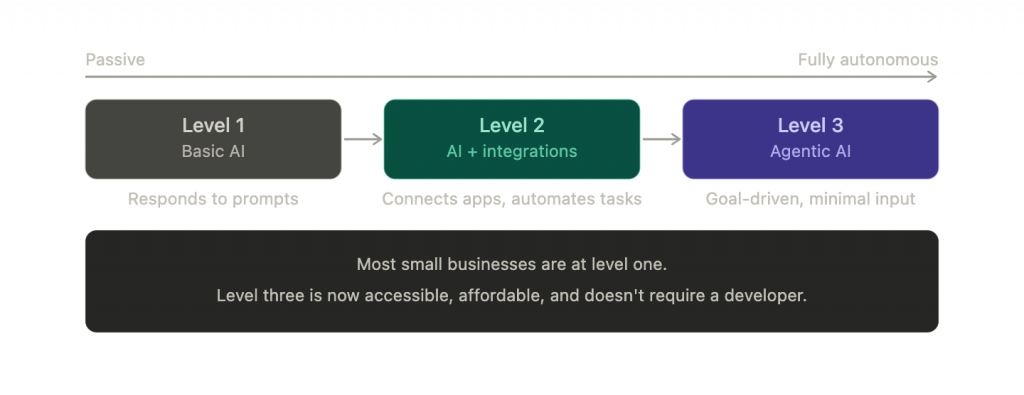
At one end of the spectrum, basic AI tools are helpful, responsive, and passive.
In the middle of the spectrum, you get AI with integrations: tools like Zapier that connect apps and automate repetitive sequences.
At the far end, you get fully agentic systems that hold a goal in mind, navigate multi-step workflows, respond to changing conditions, and complete tasks with minimal input.
Most small businesses are at level one. Level three is now accessible, affordable, and doesn’t require a developer.
Three scenarios where agentic AI saves real hours
Client follow-up and chasing
An agent monitors your inbox, identifies unresponsive leads after a set number of days, drafts a follow-up in your voice, and either waits for your approval or sends automatically, depending on your preference.
Content scheduling and publishing
You write the post, log into the platform, resize the image, pick the time, repeat for each channel. It’s competent, necessary work, but it quickly eats your highest-energy hours.
With agentic AI, you brief the agent on the week’s theme. It drafts, formats for each platform, and schedules at the optimal time. You review or you don’t, depending on how much you trust it.
Inbox triage and response drafting
Every email gets the same slice of your attention, whether it’s a new client enquiry or a newsletter you never signed up for. Your best hours go to your lowest-priority messages.
An AI agent can categorise incoming email by urgency and type, draft responses for the routine ones, and flag only the messages that need your direct judgment.
Your inbox becomes a prioritised list instead of an undifferentiated pile.
What agentic AI isn’t
Agentic AI works best when you give it clear goals, decent input data, and some human oversight at the start.
Letting it run entirely unsupervised on day one is how you end up with an agent booking appointments at 3am or chasing a client you were deliberately leaving alone.
It won’t replace your judgment on high-stakes decisions, relationship-sensitive conversations, or anything requiring genuine strategic thinking.
| Use it for | Keep a human in the loop for |
| Repeatable, rule-based tasks | High-stakes client negotiations |
| First-draft generation with your review | Legal, financial, or compliance decisions |
| Scheduling, routing, and reminders | Nuanced relationship-sensitive communications |
| Monitoring, flagging, and alerting | Brand-critical output without a proper brief |
How to know if you’re ready for agentic AI
You don’t need a technical background, a developer on staff, or a large budget. Three questions:
- Do you have at least one task you do the same way every week?
- Do you use any cloud-based tools: email, calendar, a CRM, invoicing software?
- Do you have 30 to 60 minutes to set something up properly once?
Yes to all three means you’re ready.
Where to start with agentic AI without breaking anything
AI-native tools with built-in agents
Many tools you already use have added agentic features over the past 18 months. Notion AI, HubSpot’s AI suite, and Zapier’s AI-powered automations all fit here. Low friction, familiar interface, fast first win.
No-code workflow builders with AI steps
Platforms like Make and n8n let you design multi-step automations and slot AI actions into them without writing code. More flexible, still well within reach for any non-technical business owner.
Custom agent setups
Building directly with Claude or GPT-4 via API gives you the tightest fit with your specific business and the most operational flexibility. This is also where having someone guide the build saves you from expensive early mistakes.
The honest truth about where agentic AI is right now
It’s useful, but not entirely invisible yet. You’ll hit rough edges: tasks it handles badly, integrations that don’t quite work, and outputs that need a second look. Anyone telling you otherwise is selling something.
But the small businesses building with it now will have a meaningful operational head start in 12 to 18 months.
The learning curve flattens fast once you’ve run one successful agent through a full workflow. The second one takes a fraction of the time. The third becomes instinct.
If you’re not sure which level of agentic AI makes sense for your business, book a free 30-minute call to explore your options.