


The hardest numbers in healthcare have barely moved in decades. Only 10% of drug development projects make it all the way from Phase I to approval, suggesting that 90% of drug candidates fail clinical trials.
Roughly two-thirds of the world’s population has no access to medical imaging. The world faces a projected shortfall of about 11 million health workers by 2030, most of it in low- and middle-income countries, and an estimated 8.21 million young people now turn to chatbots for mental health advice, most of which were never built for the job.
These are the bottlenecks the companies below aim to remove. I’ve grouped 24 of them into five categories, each one targeting a specific constraint; with a defensible asset such as a dataset, chip, or clinically supervised model; and with the funding or traction to keep going.
AI drug discovery and biology
Most drug candidates fail due to thin early data and research moving one target at a time. This group of startups tackles that directly.
Recursion runs millions of cell experiments to build maps of biology, a dataset now spanning more than 50 petabytes. It moved a cancer candidate from biology to preclinical stage in under 18 months. It raised $436 million in an IPO in 2021.
Transcripta Bio maps how thousands of drugs affect 20,000 human genes at once, then predicts responses to billions of new compounds. It has raised $10 million so far.
Antiverse designs antibodies for “undruggable” targets and can reach a therapeutic-grade candidate in under four months. It’s done this on a $9.3 million Series A, with $20 million raised so far.
Converge Bio runs AI systems for antibody and protein work, reporting 4 to 7x protein yield gains per computational iteration on a $25 million Series A, bringing its total to $30 million raised.
The rest of the cluster pushes on adjacent problems.
deepmirror gives medicinal chemists no-code AI drug design on a $2.4 million seed.
10x Science automates the analysis of mass spectrometry data to characterise protein therapeutics, delivering molecular insights in minutes where manual workflows take months, on a $4.8 million seed.
OmTx screens proteomes against hundreds of millions of molecules in the lab, then sells the binding data and the models trained on it, returning results in four to six weeks.
UK-based Ignota Labs rescues drugs that failed on safety issues using its AI model SAFEPATH, applying deep learning to combined bioinformatics and cheminformatics datasets, on a $6.9 million seed round.
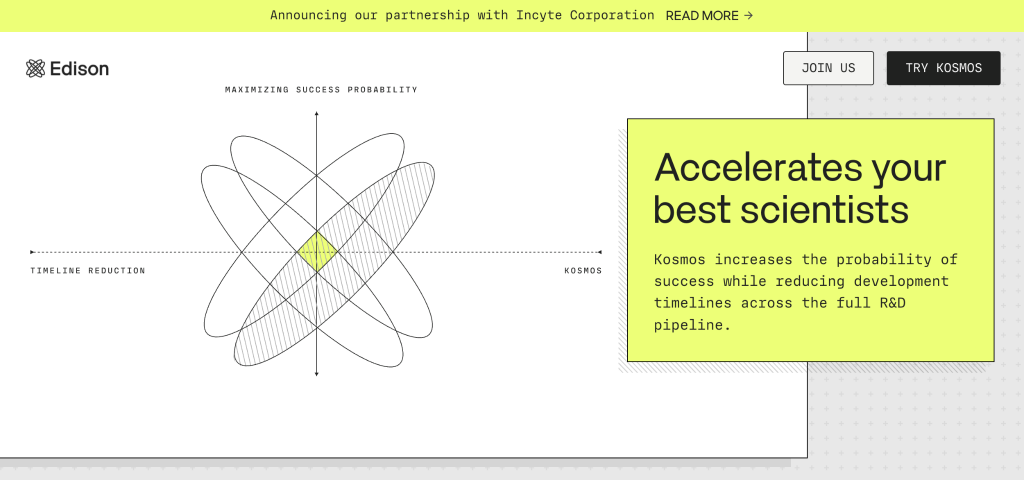
Edison Scientific’s Kosmos platform runs autonomous scientific workflows and has partnered with Incyte to embed it in the drugmaker’s R&D, on a $70 million raise.
| Company | What it does | Funding | Traction |
| Recursion | Maps of biology from millions of cell experiments | NASDAQ: RXRX | 50+ petabytes; cancer candidate to preclinical in <18 months |
| Transcripta Bio | Predicts drug effects across 20,000 genes | $10 million | TIME100 Most Influential Companies 2024 |
| Antiverse | Antibody design for undruggable targets | $9.3 million Series A, $20 million+ total | De novo antibodies in <4 months |
| Converge Bio | AI systems for antibody and protein design | $25 million Series A, $30 million total | 40+ partner programs; up to 7x protein yield per iteration |
| deepmirror | No-code AI molecule design | $2.4 million seed | Antimalarials with 10x less off-target activity in one hour |
| 10x Science | AI analysis of mass-spec data for proteins | $4.8 million seed | Molecular insights in minutes vs months |
| OmTx | Proteome-scale molecular screening, sells data and models | Not disclosed | Hundreds of millions of molecules; results in 4-6 weeks |
| Ignota Labs | AI drug rescue on safety failures (SAFEPATH) | $6.9 million seed | First asset (PDE9A inhibitor) heading to clinic |
| Edison Scientific | Autonomous AI scientist (Kosmos) | $70 million seed | FutureHouse spinout; Incyte R&D partnership |
AI diagnostics, imaging, and devices
Imaging and continuous monitoring have historically been costly, lab-bound, or both. The barrier this cohort solves is access.
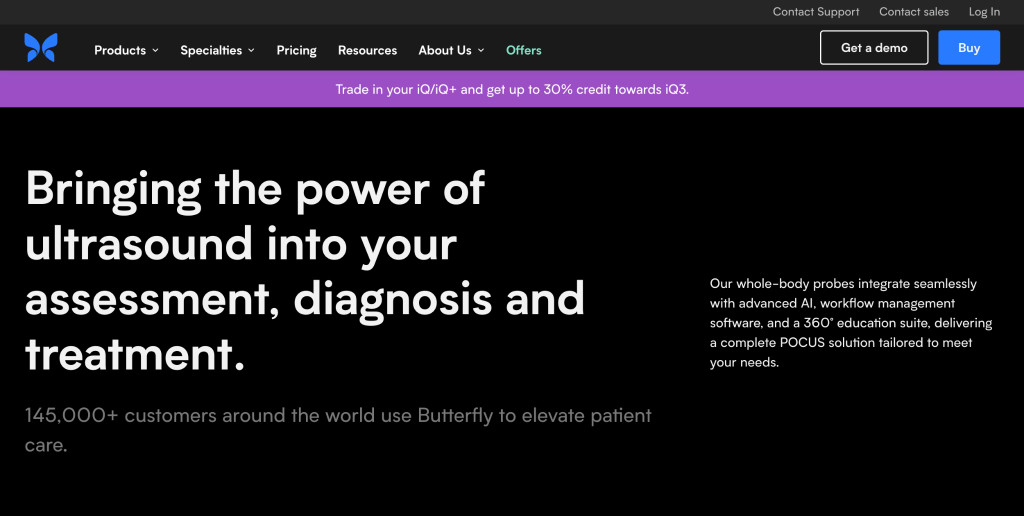
Butterfly Network replaced the bulky ultrasound probe with a semiconductor chip. Its iQ3 device runs whole-body scans from one handheld unit and reported $97.6 million in revenue in 2025, according to an SEC filing.
Mexican healthtech Eden built an AI-powered radiology operating system serving 1,800+ medical institutions across 17 countries, having raised a $22 million Series A in 2025 and $10 million in 2024, for $32 million so far.
Waiv, spun out of Owkin in 2026, turns routine digital pathology and clinical data into AI precision tests for oncology, supporting biomarker detection, outcome prediction, and treatment-response assessment, on a $33 million round.
Adaptyx, a Stanford spinout, presented the first in-human continuous multi-day free cortisol data in 2026 using a DNA-based molecular switch patch, on $23 million raised since inception.
| Company | Focus | Funding / traction |
| Butterfly Network | Ultrasound-on-chip imaging | NYSE-listed (BFLY), $97.6 million 2025 revenue |
| Eden | AI radiology operating system | $32 million raised; 1,800+ medical institutions |
| Waiv | AI precision testing for oncology from digital pathology | $33 million on spinout from Owkin; dual CE-marked under IVDR |
| Adaptyx | Continuous molecular monitoring | $23 million raised; 400 hours of IRB-approved in-body monitoring |
Clinical operations and capacity
With this cohort, the shared problem is administrative drag and too few clinicians for the demand.
Akido Labs lets a trained medical assistant run a visit while its ScopeAI reasons through diagnosis and treatment under physician oversight; it raised a $60 million Series B. Their previous raises ($11.2 million Series A, $3.5 million debt financing) bring their total funding to date to $74.7 million.
Insight Health’s Lumi, an intake AI agent, interviews patients before appointments by voice or text and writes a structured note into the EHR, which the company says cuts history-taking time by up to 50% and saves providers up to two hours a day. It raised $11 million in 2026 and $4.6 million in 2024, for a total of $15.6 million to date.
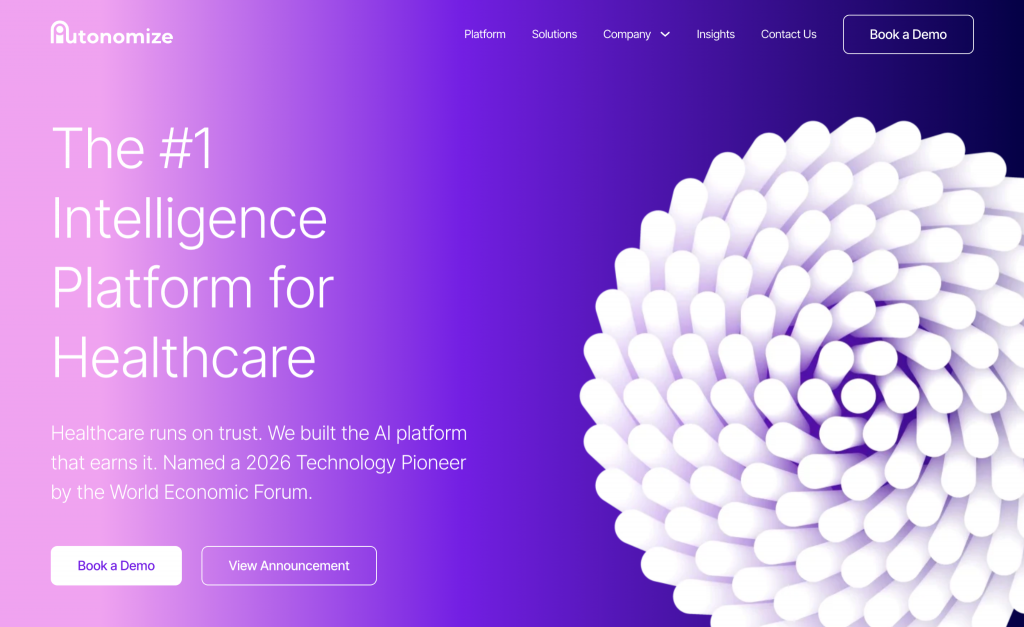
Autonomize AI offers 160+ configurable agents for prior authorisation, claims, and care management, deployed across three of the five largest US health enterprises. It has raised $32 million in total so far, with $28 million in Series A funding.
Two companies target less visible failures.
Codoxo runs a generative-AI payment integrity platform for health plans, catching billing fraud and payment errors across the claim lifecycle, and raised a $35 million Series C led by CVS Health Ventures, bringing total funding to over $75 million.
Translucent AI gives hospitals real-time financial monitoring across their many systems, built around the founder’s point that this $5 trillion industry runs on roughly 1% margins—by some estimates, even less. The startup raised a $27 million Series A led by GV and a previous $7 million seed round, for $34 million in total funding to date.
| Company | Problem removed | Traction |
| Akido Labs | Physician shortage | $74.7 million raised |
| Insight Health | Intake admin burden | $15.6 million raised |
| Autonomize AI | Workflow fragmentation | $32M raised, three top-5 US health systems deployed |
| Codoxo | Documentation fraud | $75M raised |
| Translucent AI | Hospital insolvency | $34M raised |
AI mental and behavioural health
With 8.2 million young people seeking mental health advice from chatbots, and over 1 million weekly ChatGPT conversations reportedly carrying signs of suicidal planning, patient supervision has become a design question.
Headlamp Health‘s Lumos AI brings multimodal data together to subtype neuropsychiatric patients and align treatments to responders, across both drug development and clinical care, on 100 million+ longitudinal data points.
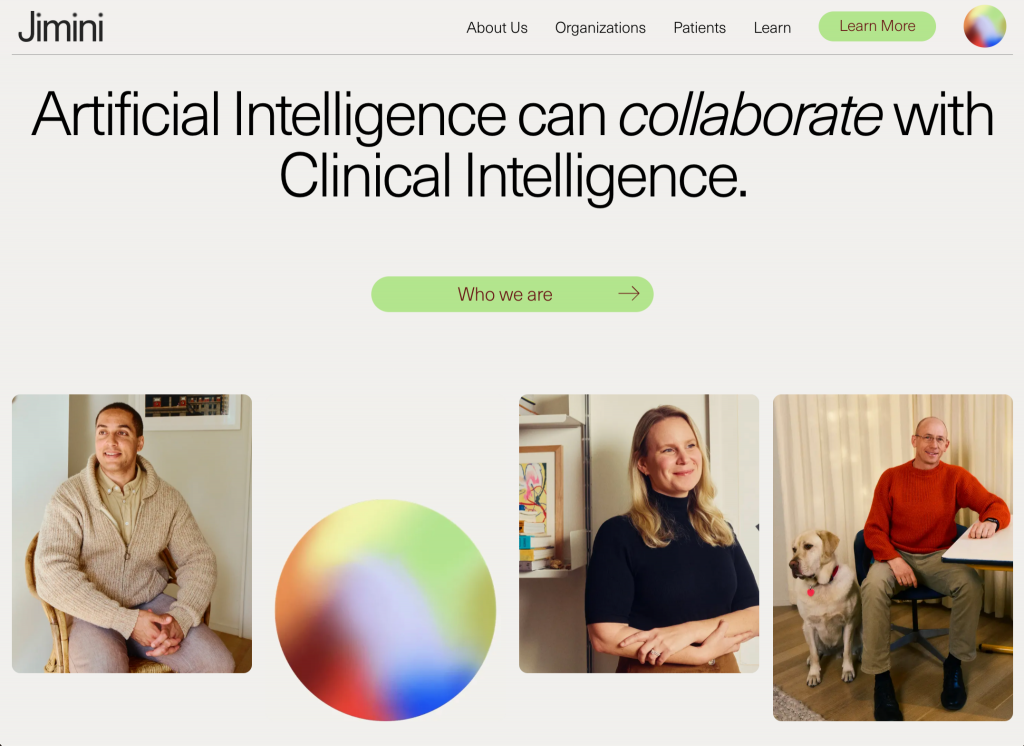
Jimini Health‘s Sage works inside provider organisations, with a licensed clinician overseeing every interaction; it raised a $17 million seed with $25 million raised in total to date. The AI behavioural health assistant provides support and reminders for patients before, between, and after sessions.
| Company | What it does | Funding | Traction |
| Headlamp Health | Neuro-symbolic AI for neuropsychiatric drug development (Lumos AI) | Undisclosed | 100M+ longitudinal data points |
| Jimini Health | Clinician-supervised AI therapy (Sage) | $17M seed, >$25M total | Licensed clinician oversees every interaction |
AI specialist care, surgery, and longevity
This group spans high-skill and long-horizon problems.
Andromeda Surgical builds autonomous surgical robotics with AI navigation guidance, and its platform performed the world’s first robotic-assisted HoLEP, a prostate procedure, in December 2024.
Inspiren‘s AUGi device monitors senior living residents with wall-mounted sensors and AI that tracks body movement to flag falls, cutting bedroom falls with injury by up to 86%. It has raised $155 million so far, including $100 million in Series B funding.
Hello Patient runs conversational AI agents that book appointments, answer questions, and re-engage patients across voice and text, handling 10,000 to 20,000 conversations a day. It raised a $22.5 million Series A round in 2025 and $6.3 million in seed funding in 2024, bringing its total funding so far to $28.8 million.
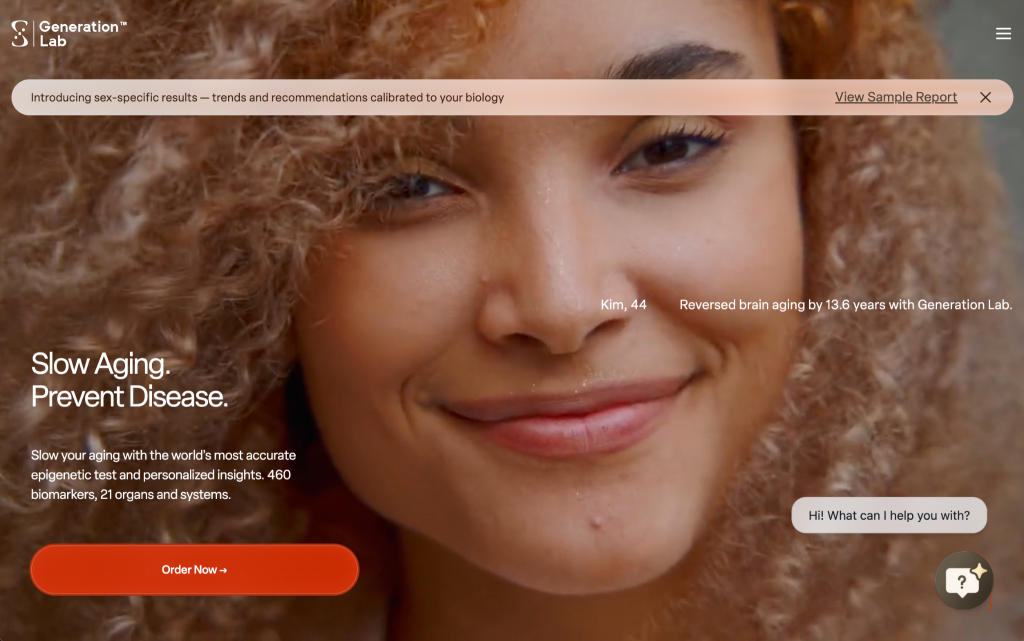
Generation Lab measures biological age across 21 organ systems with its SystemAge platform, drawing on 300 million aging data points on a $15 million total raise.
| Company | What it does | Funding | Traction |
| Andromeda Surgical | Autonomous surgical robotics with AI guidance | Not disclosed | World’s first robotic-assisted HoLEP (2024) |
| Inspiren | Privacy-safe AI monitoring for senior living (AUGi) | $155 million total | 86% fewer bedroom falls with injury |
| Hello Patient | Conversational AI for patient engagement | $22.5M Series A, $28.8M total | 10,000-20,000 conversations/day |
| Generation Lab | Biological-age diagnostics (SystemAge) | $11M seed, $15M total | 275+ clinic partners, 21 organ systems |
What these 24 AI healthcare startups share
None of these companies are trying to replace clinical judgment—there’s still a human in the loop.
Rather, each removes a constraint that stops good judgment from happening: the slow pipeline, missing scan, unavailable doctor, unsupervised chatbot, unseen fall, or financial blind spot.
| Category | Companies | Constraint |
| Drug discovery | 9 | Slow, data-poor research |
| Diagnostics and devices | 4 | Cost and access to monitoring |
| Clinical operations | 5 | Admin drag and capacity |
| Mental health | 2 | Unsupervised AI use |
| Specialist and longevity | 4 | Variable skill, late detection |
The ones most likely to last are those that picked a specific bottleneck, built a data asset or device around it, and showed the intervention works. It remains to see how each handles regulation, liability, and clinical validation.
Work with AI in Healthcare
The companies above are building real tools on hard problems, and most of them started with a narrow, well-chosen use case rather than a grand plan.
If you’re thinking through where AI fits in your own organisation, I work with teams to design workflows, review the tools already in use, and help people get comfortable putting them to work.