


Anthropic launched Claude Fable 5 on June 9, 2026, describing it as a Mythos-class model made safe for general use.
The company released it next to Claude Mythos 5, a restricted version built for cyber defenders.
Below is a breakdown of what both models do, how they’re priced, and what’s changed.

Fable 5 and Mythos 5: What’s the difference?
Fable 5 and Mythos 5 are the same underlying frontier AI model with different safeguards. Fable 5 ships with safety classifiers active for everyone.
Mythos 5 has some of those safeguards lifted, and it goes to a small group of cyberdefenders and infrastructure providers through Project Glasswing, in collaboration with the US government.
Anthropic places Mythos-class models a tier above its Opus class in capability. The first, Claude Mythos Preview, arrived in April 2026.
Mythos 5 now upgrades it, and Anthropic says it holds the strongest cybersecurity skills of any model in the world as of today.
How Claude’s Fable 5 model performs
Anthropic reports that Fable 5 reaches state of the art on nearly all tested benchmarks, with its biggest leads on longer and more complex agentic tasks.
Agentic coding is where the spread is widest. On SWE-Bench Pro, Fable 5 scored 80.3% against 69.2% for Claude Opus 4.8 and 58.6% for GPT-5.5.
On Cognition’s FrontierCode, which checks whether models meet production code standards, the spread grows: Fable 5 hit 29.3, more than double Opus 4.8’s 13.4 and roughly five times GPT-5.5’s 5.7.
The model also uses fewer tokens than past Claude models for the same work.
These agentic gains show up in early demos: Stripe ran a test on a 50-million-line Ruby codebase, and Fable 5 completed a codebase-wide migration in a day that a full team would have spent over two months doing by hand.
On vision, Fable 5 became the new state of the art. It can rebuild a web app’s source code from screenshots alone, and it beat Pokémon FireRed using a vision-only harness, where earlier models needed extra tools to play at all.
On knowledge work, Fable 5 posted the highest score on Hebbia’s Finance Benchmark for senior-level reasoning, with strong results on chart and table reading.
The trading firm IMC said the model aced nearly all of its trading-analysis tests.
On memory and long context, Fable 5 stays focused across millions of tokens and improves its work using its own notes.
When playing the deck-building game Slay the Spire, persistent file-based memory boosted its results three times more than it did for Opus 4.8.
What Mythos 5 did in science
Most of the science results came through Mythos 5.
In drug design, Anthropic’s internal protein experts sped up parts of the process by around 10 times.
Working with protein design tools and no human help, the model chose binding sites, ran the tools, and recovered from its own failures.
Of the protein targets in the study, 9 of the 14 produced strong candidates the company is now investigating.
Mythos 5 is also Anthropic’s first model to produce novel scientific hypotheses on a regular basis.
In blind comparisons against Opus-class models, the company’s scientists preferred Mythos 5’s molecular biology hypotheses about 80% of the time.
One hypothesis, a new mechanism for an E. coli protein, was later backed up by an independent lab.
In genomics, Mythos 5 worked largely on its own for over a week. It assembled single-cell data across 138 animal species, then designed and trained a custom model that beat a recent model published in Science while being 100 times smaller.
The new safeguards for Claude’s Fable 5
Fable 5 ships with a fresh set of AI classifiers: separate systems that detect possible misuse and jailbreak attempts.
The design choice here is a fallback; when the classifiers flag a request in a covered area, Claude Opus 4.8 answers instead, and the user gets told when this happens.
The classifiers cover three areas: cybersecurity, biology and chemistry, and distillation (attempts to copy the model’s abilities).
| Classifier area | Why Anthropic flags it | What happens to the request |
| Cybersecurity | Mythos-class models can find and exploit software flaws, making attacks cheaper to run | Blocked from making progress; falls back to Opus 4.8 |
| Biology and chemistry | Dual-use research could give uplift to malicious actors | Most requests fall back to Opus 4.8 |
| Distillation | Large-scale attempts to copy the model’s abilities to train rivals | Flagged requests fall back to Opus 4.8 |
Anthropic tuned the classifiers to be cautious, so some harmless requests get caught (for example, it threw up a flag while putting together the research for this piece).
The company says the safeguards trigger in fewer than 5% of sessions on average, and that more than 95% of Fable sessions involve no fallback at all. For those sessions, Fable 5 performs the same as Mythos 5.
On robustness, an external bug bounty ran over 1,000 hours and produced no universal jailbreaks, though the UK AISI made progress toward one in early testing.
One internal red-team test ran an automated attacker across 400 turns on a short cyber task, restarting whenever it got blocked.
Pricing and data retention for Claude Fable 5 and Mythos 5
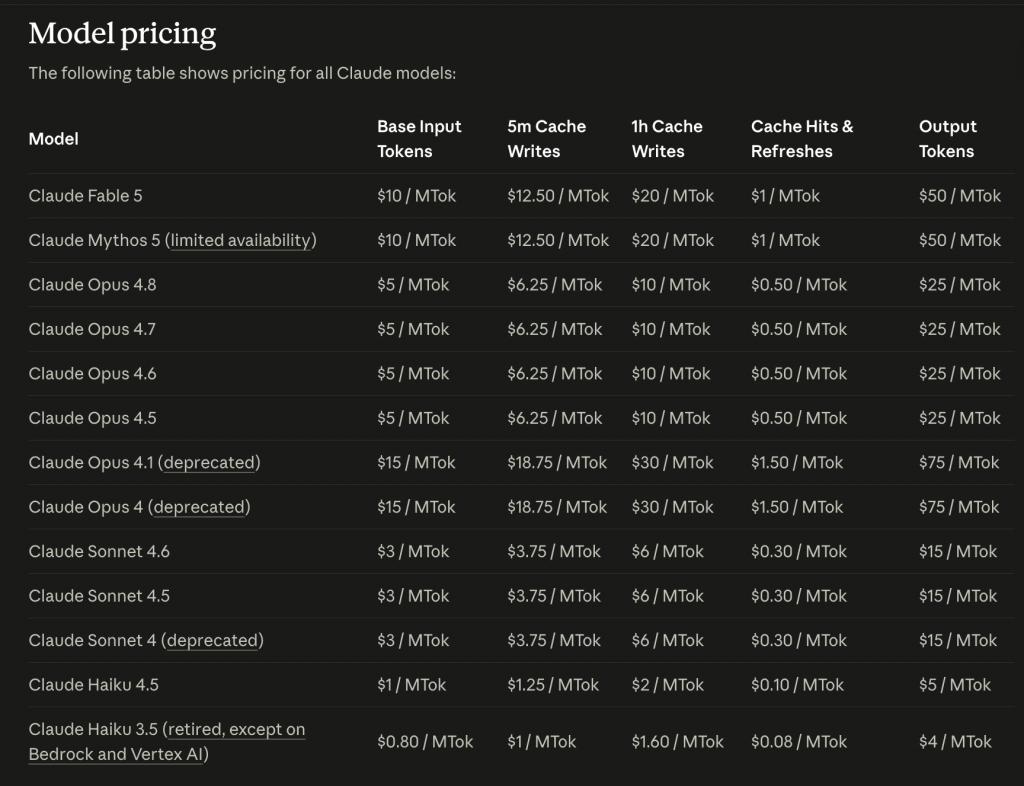
Both models cost $10 per million input tokens and $50 per million output tokens, less than half the price of Mythos Preview.
Anthropic also changed how it handles business customer data for Mythos-class models.
The company will require 30-day retention for all traffic on these models across first- and third-party surfaces.
It won’t use the data to train new models, and it says it deletes the data after 30 days in almost all cases.
The stated purpose is defending against complex attacks and reducing false positives.
Claude Fable 5: Availability and the subscription rollout
Fable 5 is available everywhere today. Mythos 5 stays restricted to Glasswing partners, with select biology researchers joining a trusted access program soon.
Developers can call the model as claude-fable-5 through the Claude API, where it’s fully available now.
For subscription users, Anthropic is rolling out in stages to manage demand.
| Window | What you get |
| Today to June 22 | Fable 5 included on Pro, Max, Team, and seat-based Enterprise plans at no extra cost |
| From June 23 | Fable 5 removed from those plans; using it requires usage credits |
| After capacity allows | Anthropic aims to restore Fable 5 as a standard part of subscription plans |
The company says it will flag any changes ahead of time so users know where things stand.
Level up with Claude training
Want your team using Claude Fable 5 well from day one?
My Claude training sessions cover prompting, workflows, and governance so your people get reliable results without the trial and error.
Book a session to level up your team.