


TLDR: Agent shopping only scales when stores become readable and payable by machines. The first agents shopped by impersonating people on human-facing sites, which broke and drew a lawsuit. So the industry is building shared rails: open protocols like MCP, ACP, UCP, and AP2, and new agent payment systems from Stripe, Visa, and Mastercard.
Follow the series: Part 1 • Part 2 (this) • Part 3 • Part 4 • Part 5 • Part 6 • Part 7
In November 2025, Amazon sued Perplexity. Its Comet browser had been shopping on Amazon for users by disguising itself as an ordinary Chrome session to slip past detection.
In March 2026, a federal judge blocked Comet from Amazon, finding it had reached customer accounts without Amazon’s authorization. Days later, an appeals court paused that order while it reviewed the appeal.
Amazon said it spent more than $5,000 and many engineering hours building tools to block the agent, then changed its seller terms to require every AI agent to identify itself.
That case shows the flaw in the first wave of agent shopping. Agents bought things by pretending to be human on sites built for humans—a brittle approach now contested in court.
This is the second piece in a series on the seven layers of agentic commerce. In Part 1, we covered execution: what agents can buy today. This piece covers the layer beneath it.
Infrastructure is the set of standards and systems that let an agent read a store, fill a basket, and pay, without scraping a page meant for a person. The question for this layer: what’s being built, and how far along is it?
As before, the answer has two halves.
The industry is building a lot, fast. Anthropic’s Model Context Protocol (MCP), the open standard that lets agents connect to tools and data, launched in November 2024 and now has roughly 10,000 public servers (see them here).
OpenAI and Stripe released the Agentic Commerce Protocol (ACP) in September 2025 and open-sourced it, with about a million Shopify merchants anticipated to sell through ChatGPT.
Google announced its Agent Payments Protocol (AP2) the same month with 60+ partners, and Visa and Mastercard both shipped agent payment rails in October 2025.
But most stores can’t use any of it yet. Adobe scored US retail product pages at 66% machine-readable on average, so about a third of the content on the page where people decide to buy can’t be read by an agent.
In the UK, just 15% of the top 100 retailers say their payment contracts and systems are prepared for agent transactions. So the rails are arriving faster than stores can lay tracks to meet them.

The store has to become machine-readable
A human reads a product page by looking at it. An agent can’t, reliably. It needs structured data: a feed that states the price, the size, the stock, and the shipping in a fixed format.
ACP defines one such feed so ChatGPT can ingest a merchant’s catalog directly, rather than guess from the page.
UCP, the Universal Commerce Protocol, does a related job for Google’s AI surfaces, but goes beyond catalog ingestion into checkout and payment coordination.
Without that feed, agents fall back on browsing the human site—potentially bypassing user data and privacy controls, which is where the Amazon case started.
Adobe found product pages are the weakest part of most retail sites for machines, even as AI traffic to those sites grew 393% year over year in early 2026.
A store that wants agent sales has to publish its catalog in a form an agent can read.
A shared tool layer for agents
MCP is the layer that lets an agent talk to a tool. Anthropic built it, then donated it to the Linux Foundation in December 2025, with Block, OpenAI, Google, Microsoft, and AWS backing it. Wide adoption alleviates the lock-in worry (think USB).
In theory, a merchant can expose one MCP interface that compatible agents can use, rather than building a separate connector for every AI app.
Stripe, Shopify, and WooCommerce already run MCP servers, and the SDKs see 97 million downloads a month.
But reading the catalog is half the job. The agent also has to start a checkout, and that needs an API the merchant exposes. ACP and UCP are that API.
A merchant implements ACP or UCP once, and any compatible agent can create a cart, apply shipping, and place the order, while the merchant remains the merchant of record and keeps fulfilment, returns, and the customer relationship.
| Protocol | Backed by | What it handles | Status |
| MCP | Anthropic, Linux Foundation | Lets agents connect to tools and data sources | Open, 10,000+ servers |
| ACP | OpenAI, Stripe, Meta; maintained by OpenAI and Stripe | Catalog, cart, and checkout | Open, beta, live on ChatGPT |
| AP2 | Google, 60+ partners | Payment authorization across rails | Open, donated to FIDO |
| Visa TAP / Mastercard Agent Pay | The card networks | Agent credentials on card rails | Piloting |
Paying without handing over the card
The last piece is money. You don’t want an agent holding your card number. Stripe’s answer is the Shared Payment Token, a credential scoped to one merchant and one cart total, so an app like ChatGPT can trigger a payment without ever seeing the card.
Google’s AP2 does a related thing with signed “mandates,” a record any network can verify of what you authorized and what got charged. Visa and Mastercard are issuing their own agent credentials on the card rails.
This is the “Stripe for agents” idea: a payment primitive designed for software that buys on your behalf.
Who’s ready, and what comes next?
Adoption is uneven. In the UK, 49% of the top 100 retailers are investing in agentic AI, though most haven’t wired up the payments side.
A Payments Association survey found 58% of UK online merchants believe AI agents have already reached their platforms, yet only 3% of reported transactions involve an agent today. Merchants know it’s coming, but few are built for it.
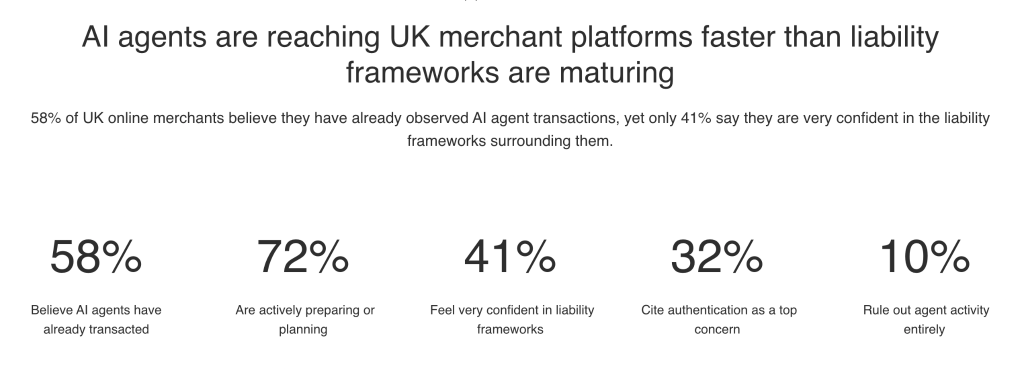
Source: The Payments Association UK
But suppose the rails are laid and the store is readable. The agent can now buy at scale. The question is: buy what?
An agent that can place any order still needs to know your budget, your brands, and what to do when the milk you want is out of stock.
That takes us into the next layer: preferences.