


A finished draft waits in a shared folder for nine days. The writer assumes the editor has picked it up, the editor assumes the strategist still owes a sign-off, but the strategist never knew the piece existed.
By the time anyone notices, the campaign it was meant to support has moved on, and the article goes out late to readers who’ve drifted elsewhere.
Scenes like that repeat across content teams every week, and they point to one missing thing: a content creation workflow.
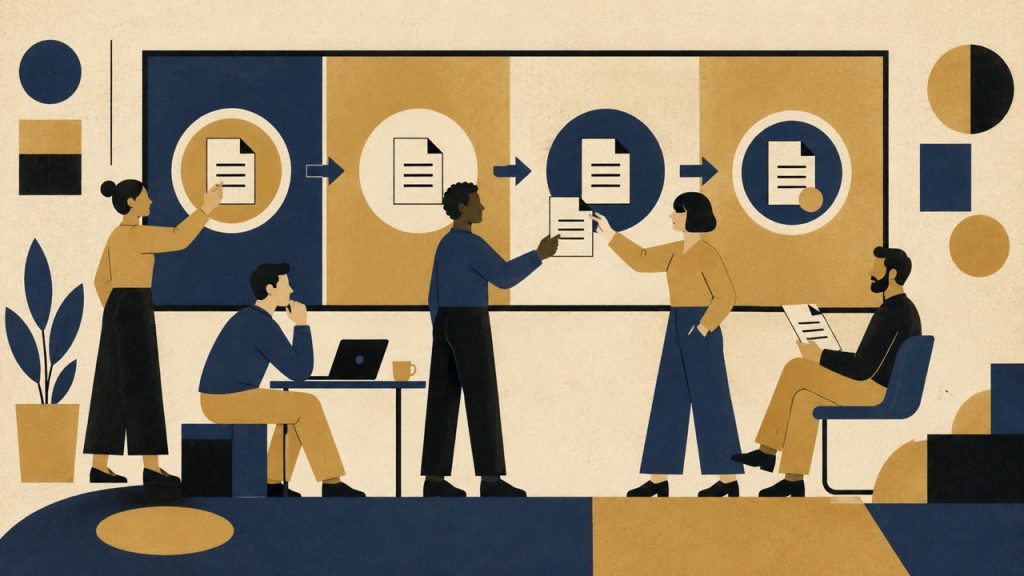
A content workflow is a repeatable sequence of stages that a piece of content moves through, from first idea to published result, with a named person at each handoff.
It replaces ad hoc content creation, where one person opens a document, writes something, and pushes it out with no brief, no review, and no agreed next step.
A content workflow forms the backbone of effective content operations—for a solo content creator or large content team.
There’s a difference between a content workflow and a content pipeline, though people often use the two terms for one idea.
A content workflow describes the human process: who does what, in what order, and where each review happens.
A content pipeline describes the wider system that moves high quality content through production and distribution, including the tools and automated steps it passes through.
One describes the people; the other describes the system that moves their output.
Content workflows exist because of scale and accountability. The Content Marketing Institute’s B2B research found that 45% of marketers lack a scalable model for content creation, and among teams with dedicated content staff, 54% run on just two to five people.
Small content teams producing rising volumes of digital content need a structure that doesn’t depend on memory or goodwill.
Done well, a content workflow turns scattered effort into predictable output: with each piece having an owner, a content brief, a review point, and a route to publication.

The 7 stages of a digital content workflow
Most long-form content moves through seven stages. The precise shape varies by team, but the sequence below covers what a working content production process tends to include.
| Stage | What it produces | Typical owner |
| Ideation | A content idea tied to a goal or keyword | Strategist |
| Research | Sources, data, and a point of view | Writer or researcher |
| Briefing | A content brief with angle, audience, and structure | Strategist or editor |
| Drafting | A first draft | Content writer |
| Review | Edits, fact-checks, and feedback on content quality | Editor |
| Approval | Sign-off against content marketing strategy and brand | Content manager |
| Distribution | Scheduled content publishing across channels | Distribution lead |
A content marketing team might track this sequence in two ways:
- A status based workflow tracks each piece by its stage, so a content calendar or board shows what’s in drafting, what’s in review, and what’s scheduled.
- A task based workflow tracks the same work by assignee, so each person sees their own queue.
Most content workflow software supports both views.
The sequence doesn’t have to run in a straight line. Some teams use a linear workflow, where each stage finishes before the next begins.
Others run stages in parallel, with design starting while copy gets reviewed, or use a rolling model where evergreen content moves through continuously. While the timing changes, the structure holds.
How content workflows differ by team and content type
In a large content team, each stage can have a dedicated owner: a content strategist briefs, a content writer drafts, an editor reviews, and a content manager signs off.
On a small team, one person often carries three or four stages, with a single handoff for a second pair of eyes.
Here’s what a small content marketing workflow looks like in practice. A founder writes the draft on Monday, a freelance editor reviews it on Wednesday, and the founder publishes on Friday.
Three stages, one external handoff, and one owner for the rest. It counts as a workflow because the stages, order, and review point are defined in advance, not improvised each time.
Content type changes the length of each stage, not whether the stage exists. A short social post moves through the same path as a long report, though research and drafting for a LinkedIn post might take far less time.
Video content adds a content production step between drafting and review. The path holds, but the time on each step changes.
What separates a working content workflow from a broken one
A working content workflow has two features at every stage: a defined owner and defined handoff.
When both are present, the content creation process keeps its quality, hits its dates, and never waits in limbo. When either breaks, the workflow fails in practice.
Two failure modes show up most often. The first is a missing goal. CMI found that 42% of B2B marketers with moderate or weak content results trace the problem in part to a lack of clear goals.
A content workflow without content goals produces work on time that points nowhere.
The second is the undocumented workflow. When the process lives only in people’s heads, it breaks the moment someone leaves the team or goes on holiday, and bottlenecks form quickly.
Bottlenecks within a content project tend to cluster at review and approval, where one editor or content manager becomes a single point of failure.
Naming a backup reviewer, or setting a fixed review window (often 48 hours), clears most of them and keeps quality content moving.
Where AI and tools fit in an existing content operation
Tools come after the process, not before it. Workflow software, from a shared Google Sheet to a full content management system, gives a content workflow a place to live.
From experience, content workflow management improves once every stage is visible in one view.
Workflow automation (with simple triggers) can move a piece from one stage to the next without a manual nudge.
AI can speed up individual stages, from content planning and drafting outlines to summarising research and repurposing.
But none of that repairs a weak workflow. A content workflow speeds up whatever process already exists, so a broken process produces broken content faster.
Map the stages of your content strategy, owners, and handoffs first. Add tools and AI second.
Getting started with publishing content faster
To build a content workflow from nothing, write down the stages existing content already moves through, name an owner for each, and mark where reviews happen.
That single page becomes a structured workflow. Everything after, from a content calendar to workflow automation, builds on and refines it.
If you want a content workflow mapped and built around how your team works, that’s the kind of project I take on. Learn more about workflows today.