
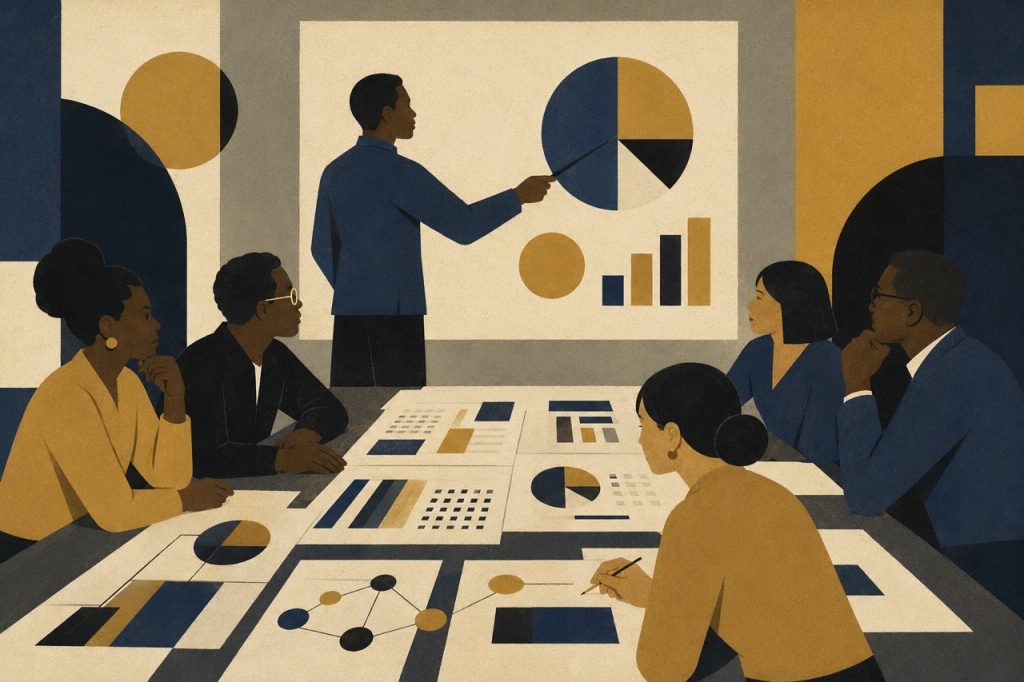

An AI audit is a structured review of how an organisation currently uses AI tools and where those tools could be better applied. The process covers key areas including tool inventory, workflow analysis, team AI literacy, governance, risk, and strategic alignment.
The audit runs across three stages: discovery, assessment, and a written report with prioritised recommendations. A free report template is also provided here for those conducting their own audit.
What an AI audit actually is
An AI audit is a structured review of how your organisation uses artificial intelligence and where it could be using it better. That second part matters as much as the first.
Most discourse around AI auditing focuses on reviewing existing AI systems for compliance, bias, or governance gaps. That’s useful work, but it’s designed for organisations that have already deployed AI at scale.
If you’re booking an audit call with me, you’re probably at a different stage: you’ve adopted a handful of tools, your team has mixed feelings about AI, and you want someone to help you make sense of it before you invest more time or money.
My job in an AI audit is to understand where you are, where AI could genuinely help your business, and what’s standing between you and that.
Sometimes that means reviewing the tools you already use. Sometimes it means looking at your workflows and asking whether AI could be doing work that your team currently does by hand.
Who books an AI audit?
The organisations that reach out to me tend to fall into one of two groups.
The first group uses AI in patches: the founder uses ChatGPT daily, a few team members have found tools they like, and the rest of the team hasn’t touched any of it.
There’s no shared AI strategy, and no one has stopped to ask whether the AI use that does exist is actually producing results.
The second group has heard enough about AI to feel like they’re falling behind. They want to figure out whether they should be investing, what that investment would look like, and whether their current workflows are even ready for it.
Both groups benefit from the same thing: an honest diagnosis.
What I look at during an AI audit
An AI audit covers two overlapping areas: your current AI use and your workflow potential. The table below outlines the key domains.
| Domain | What I’m assessing |
| AI tool inventory | What AI tools does your team use, how often, and for what? |
| Workflow audit | Where do your most time-consuming workflows live, and where could AI augment them? |
| Team AI literacy | Who on your team uses AI with confidence, and who hasn’t started yet? |
| AI output review | Do AI outputs get checked before they influence real decisions? |
| Governance | Does anyone own AI decisions in your business? Is there any shared guidance? |
| Risk and compliance | Does your current AI use create any data or contractual exposure? |
| AI strategy alignment | Does your AI use connect to your actual business goals? |
Beyond the tool inventory, the workflow audit often surfaces the most useful findings. I’ll ask you to walk me through a typical week: which tasks recur, which ones your best people spend too much time on, and where things tend to get stuck.
From that conversation, I map your highest-friction points and identify where AI could produce a genuine efficiency gain.
The team literacy assessment matters too. A recommendation to automate your proposal process means nothing if your team doesn’t trust AI outputs or doesn’t know how to supervise them. I need to know who’s ready, who’s resistant, and what would move the needle on that gap.
The AI audit process
The process runs in three stages.
- Discovery. We start with a structured conversation: you, your operations lead, and where relevant, a department head or two. I’m building a picture of your business model, your workflows, and your current AI use.
- Assessment. I work through the audit domains, map your highest-friction workflows, review your AI tool inventory, and assess the governance and risk posture around your current AI use.
- Report. You receive a written audit report with prioritised findings and recommendations, sequenced by what to do first, what can wait, and what isn’t the right fit for your business right now.
Free AI audit report template
If you’re running one yourself, use this structure to document findings from any AI audit engagement.
Client: | Auditor: | Date:
Section 1: Business and workflow snapshot. A brief summary of the business model, core revenue streams, team size, and the workflows reviewed.
Section 2: AI tool inventory. A table listing every identified AI tool: name, function, who uses it, how often, and current governance status.
Section 3: Workflow audit findings. The three to five highest-friction workflows identified, with notes on time cost, error rate, and AI applicability for each.
Section 4: Team AI literacy. An honest picture of AI literacy across the team: who’s confident, where the gaps are, and what training would move the needle.
Section 5: Governance overview. Is there a named AI owner? A written policy? An incident plan? Rate each as present, partial, or absent.
Section 6: Risk and compliance notes. Any data handling, vendor, or contractual issues flagged during the audit.
Section 7: Recommendations. Grouped by time horizon: quick wins (0 to 30 days), medium-term actions (one to three months), longer-term AI strategy work (three to six months).
What happens after an AI audit?
An audit report gives you a baseline. Most clients use it to prioritise their first meaningful AI projects, decide which tools to govern more tightly, and figure out what level of investment makes sense for their current stage.
Some take the findings and run with implementation themselves. Others bring me back in to help build from the report or set up group training. Either way, you’ll know where your business actually stands on AI and what’s worth doing next.
Book your free 30-minute AI audit call at mohammedshehu.com/audit.