

TLDR: ChatGPT ads show only to Free and Go users, in several countries, beneath the ChatGPT response, matched to the conversation’s intent, and labelled ‘sponsored’. There’s a £15 daily minimum, three objectives, one ad format for standard campaigns and a product carousel for feed campaigns, and a 25,000-user minimum for audience targeting. This guide covers how ChatGPT ads work, screen by screen from the live ad platform, and who should use them as part of their digital marketing mix.
Source: OpenAI/ChatGPT Ads Manager
Where ChatGPT advertising stands today
On 16 January 2026, OpenAI announced its approach to AI advertising (weeks after ChatGPT users pushed back on app suggestions that resembled paid ads) and began testing on 9 February with US Free and ChatGPT Go users. The self-serve beta followed in May. They’re the only one of the major AI platforms to offer self-serve ads as of writing.
Self-service access covers 52 countries as of this week: the original nine (US, UK, Canada, Australia, New Zealand, Japan, Korea, Brazil, Mexico), the EEA, Switzerland, Iceland, Norway, Liechtenstein, India, and a run of Middle East and North African markets including Egypt, Morocco, Tunisia, Algeria, Jordan, Lebanon, Iraq, Bahrain, Kuwait, Oman, and Qatar. Advertisers in the new European markets can also start through the OpenAI Ads Solutions team or agency partners.
What do ChatGPT ads look like to ChatGPT users?
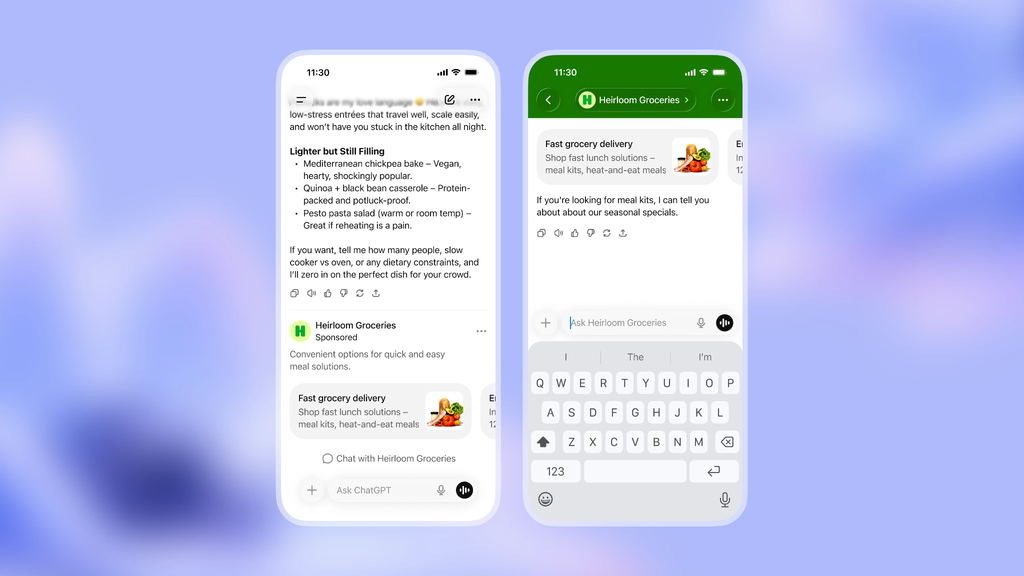
Free and Go tier users see a single sponsored placement beneath the AI response, with the advertiser name, logo, title, description, image, and link, with a sponsored label. OpenAI claims ChatGPT ads don’t influence the answer, and advertisers never see AI conversations. Plus, Pro, Business, and Enterprise users don’t see ChatGPT ads.
Source: OpenAI
Setting up your ChatGPT Ads account
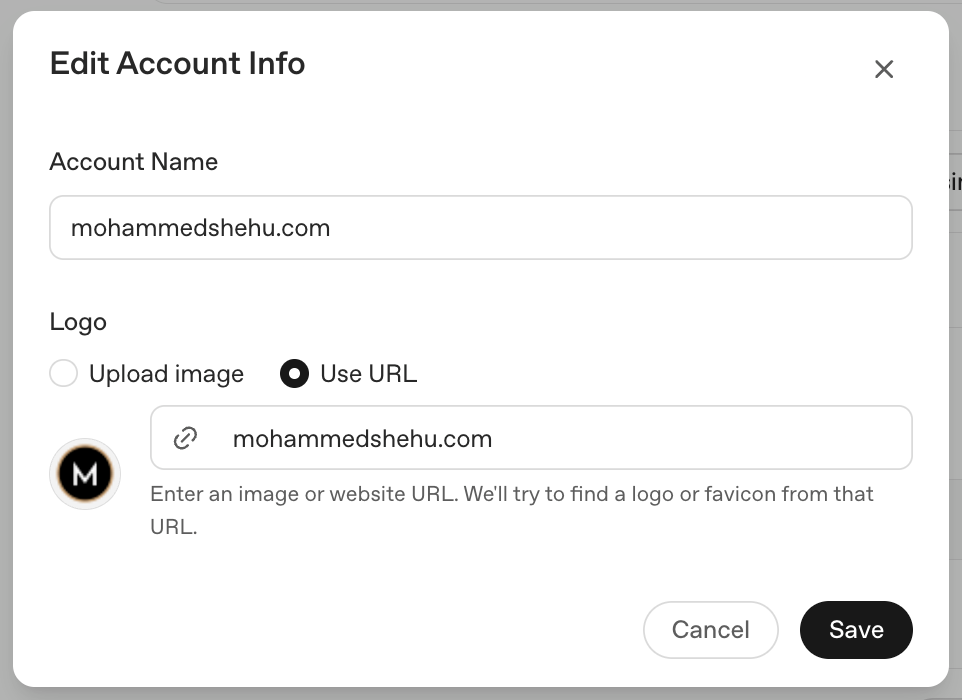
You sign up with an OpenAI login, name your account, and add a logo (a URL option scrapes your favicon). You can change these later under Settings → General.
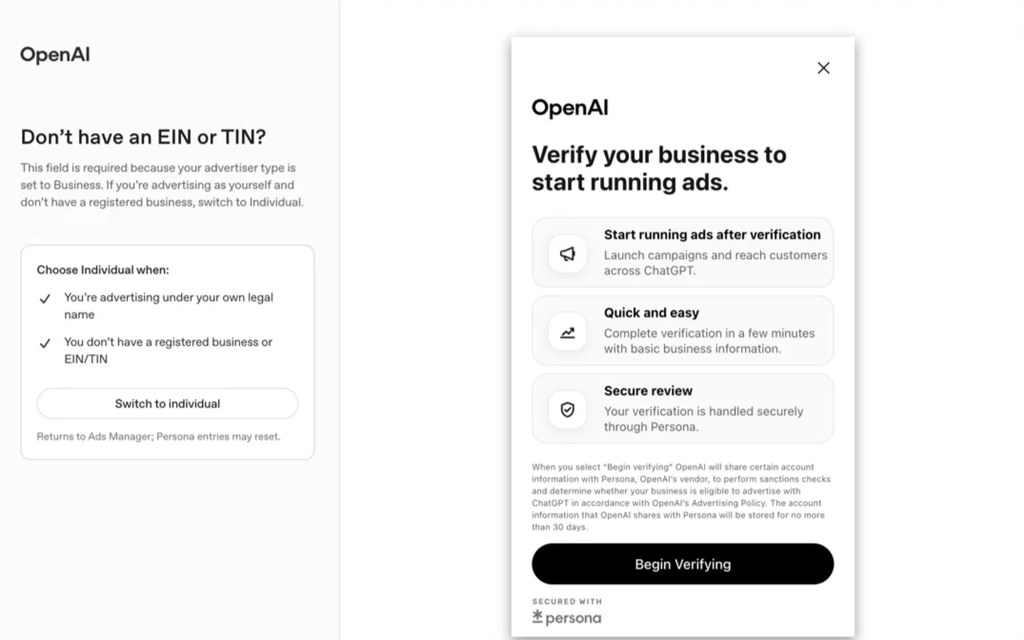
You’re then prompted to complete business verification through Persona, which runs sanctions checks with a 30 day data retention period.
Source: ChatGPT Ads Manager
You can choose to run ads as an Individual (ads run in your personal name) or a Business. If you choose the latter, UK advertisers are prompted to enter a Company Number, VAT number, industry, and physical address (no PO boxes).
You’ll see “Application in review” (should take less than a day; might be different for you) and you can continue working on ChatGPT ad campaigns in the meantime.
After you add a card, your bank shows a $100 charge, or your currency’s equivalent. This is an authorisation hold, released after verification and visible for up to 7 days.
Billing is postpay: you accrue spend until it reaches a threshold assigned to your account (starting at £25), which rises with payment history. You’ll have to create a billing profile before you can run ChatGPT ads.

How to build a ChatGPT ad campaign
Ads Manager uses the familiar three-level hierarchy of campaign, ad group, and ad.
| Level | Fields | Limits |
|---|---|---|
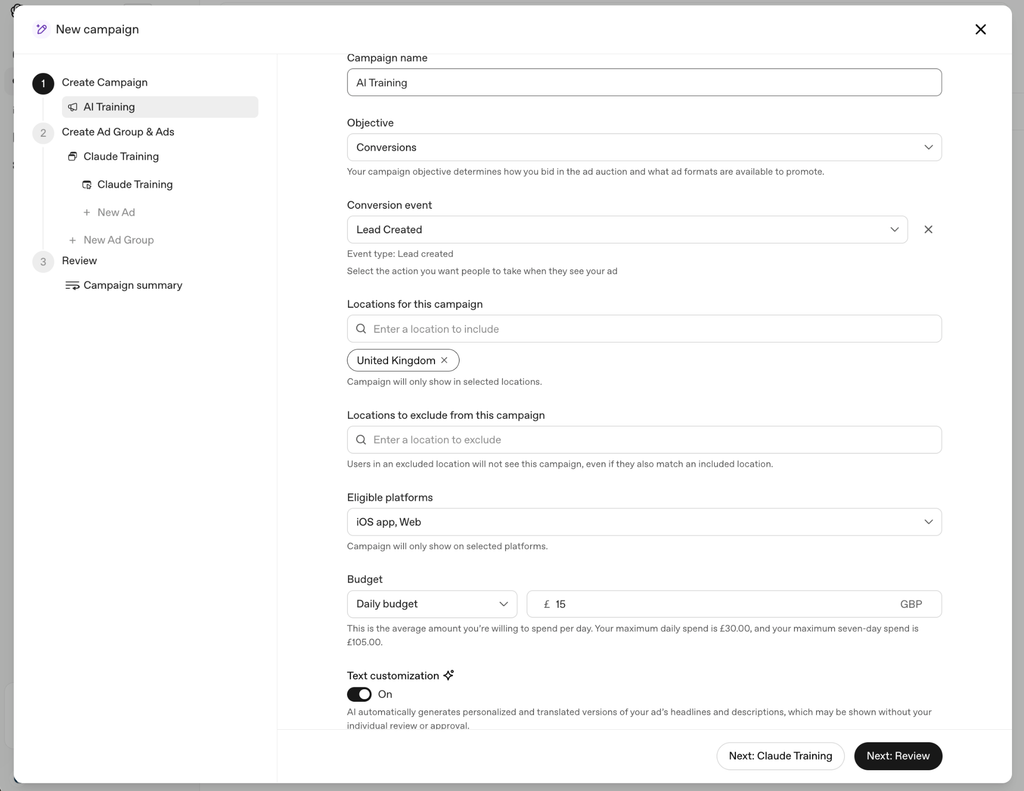
| Campaign | Objective (Reach, Clicks, Conversions), countries to include and exclude, platforms (iOS, Android, Web), daily or total budget, start and end dates, custom audiences, Text customization toggle | £15/day floor; maximum daily spend 2x, seven-day spend 7x |
| Ad group | Bid strategy (Maximize results or Manual max bid), audience bid multipliers, landing page query parameters, default destination URL, context hints | CPM bid 0.01 to 5,000 under Reach; conversion-optimised bid cap under Conversions, billed per click |
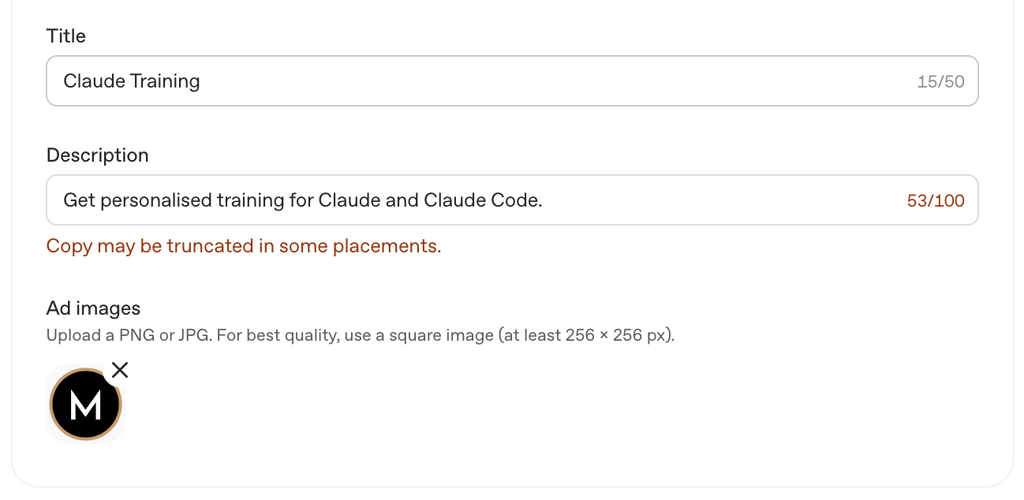
| Ad | Name, destination URL, title, description, one square image | Title 50 characters, description 100, image 256×256 minimum, PNG or JPG |
You can now pace your campaign’s total budget across the flight instead of front-loading it; daily spend varies with available inventory.
Text customization is on by default, and AI-generated, personalised, translated versions of your headlines “may be shown without your individual review or approval.” You set these at the Campaign level.
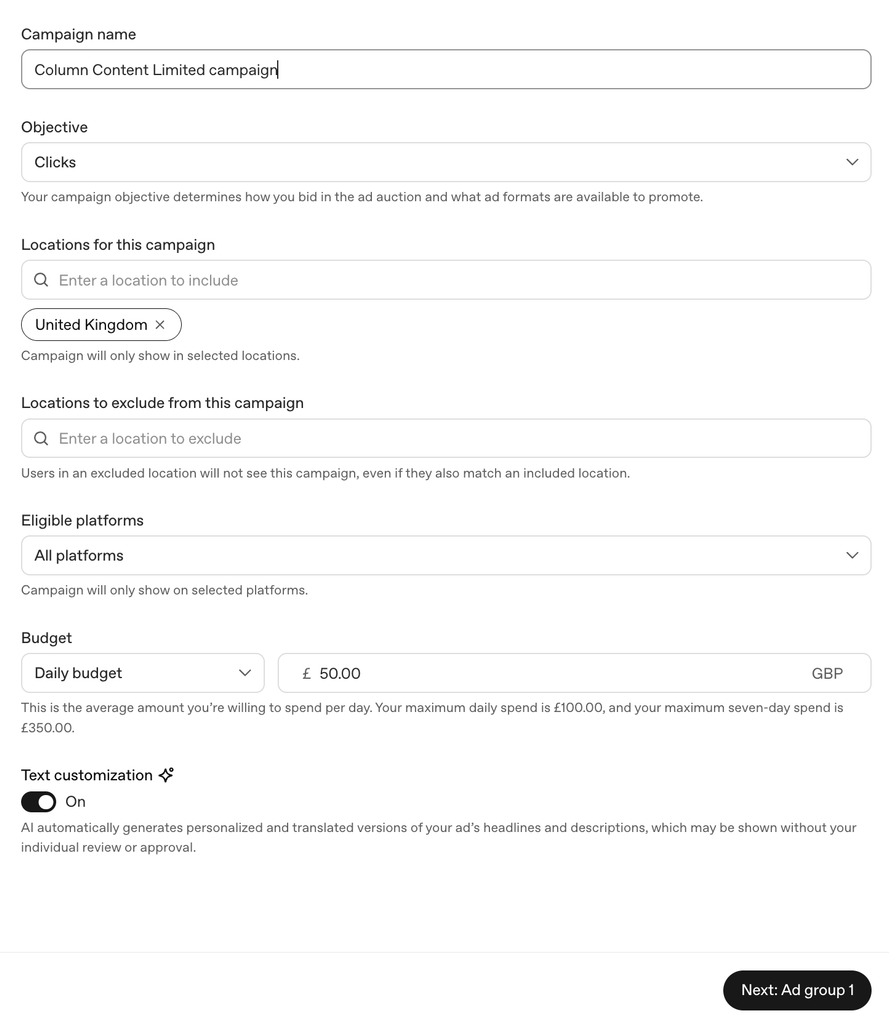
Context hints describe the conversations and intent where your product might be relevant, with the form stating they “guide matching but aren’t exact-match targeting rules.” You set this at the Ad Group level.
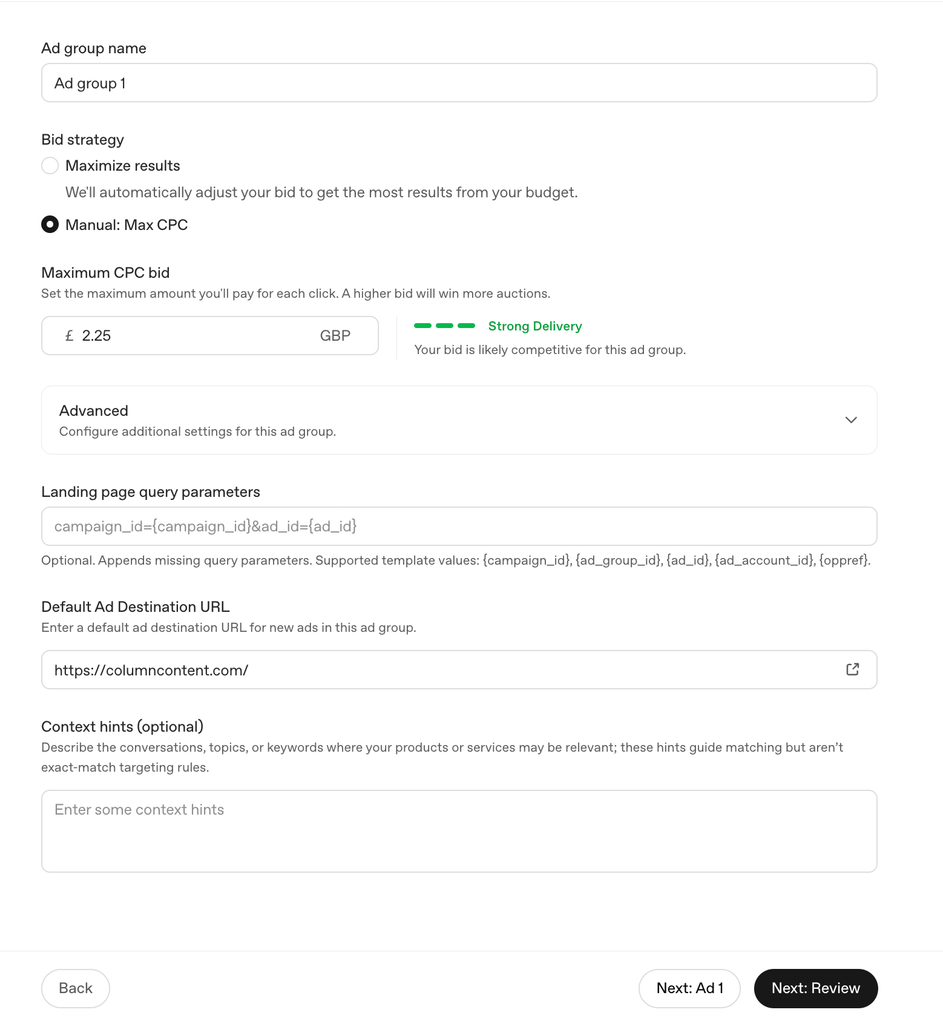
OpenAI’s targeting inputs are conversation context, user intent, landing page content, headline, and description. So there are no keywords to buy.
A free user’s conversation supplies commercial intent (“I need a tool to track my team’s invoices”), ChatGPT reads that intent against your landing page, and the page has to admit OAI-AdsBot and OAI-SearchBot.
Title text on ChatGPT Ads is 50 characters max; description text has a 100 character limit. You enter these at the Ad level.
Conversion tracking
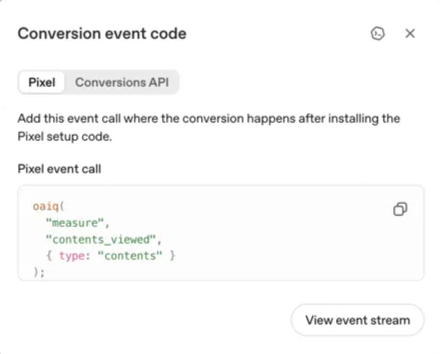
Under Tools, you can create a data source for your website, then a conversion event from 12 base events (page viewed, lead created, order created, trial started, and so on).
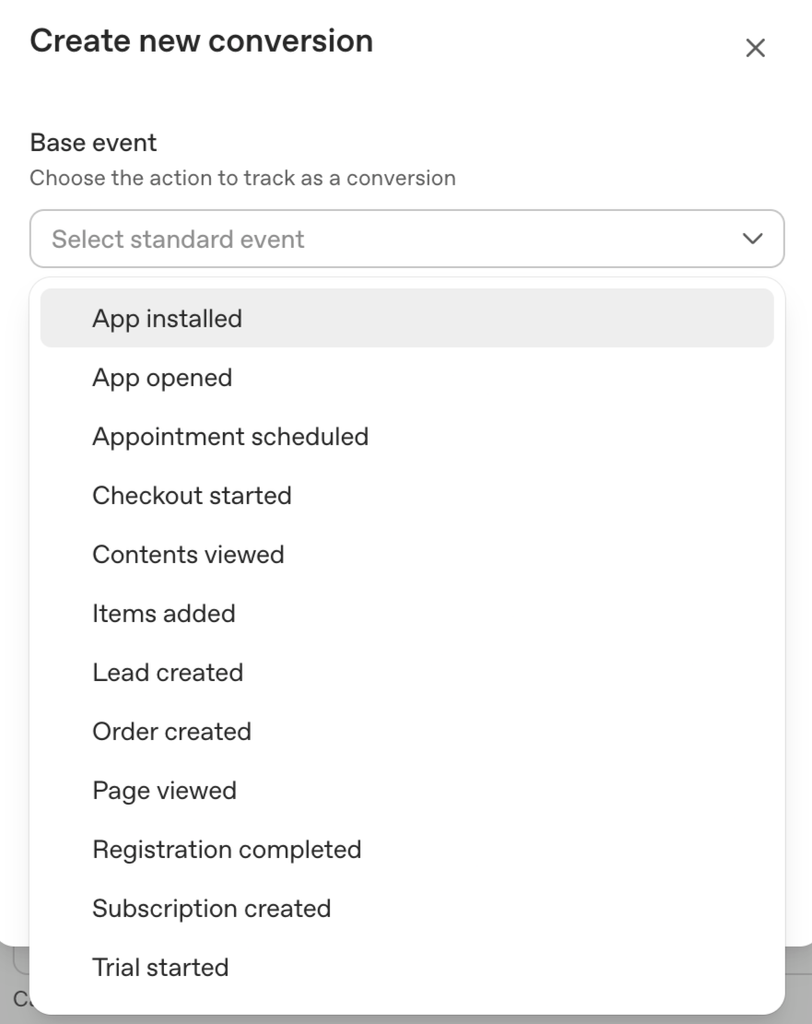
Each event gets a 30-day click-through window (other windows “will come soon”). The platform then hands you a pixel call or a Conversions API payload.
OpenAI appends a click reference called oppref to your landing URL, stores it in a first-party cookie, and matches later events against it. If you send the same conversion from pixel and API, you reuse one event ID so it counts once.
Matching now goes beyond the click reference. Your created pixel accepts hashed phone, first name, last name, region, and postal code, and the Conversions API takes lists of hashed emails, phones, external IDs, names, country, city, region, postal code, and Android GAID.
OpenAI has also announced a view-through campaign type, billed on impressions and optimised to conversions from both clicks and views; it hasn’t rolled out broadly yet as of writing.
Custom audiences, exclusions, and the empty-list quirk
Custom audiences in ChatGPT Ads are uploaded lists: raw or SHA-256 hashed emails and phone numbers, or Android advertising IDs, as CSV or TXT, with all five identifier types allowed in one file. You can add, remove, or replace members without recreating the audience, merge up to 64 audiences into one, and build lists above 5 million members, with matched counts reported as ranges instead of exact figures.
Inclusion targeting and bid multipliers need at least 25,000 matched users. Exclusion works at any size, and since the 25 August API update, even an empty audience qualifies.
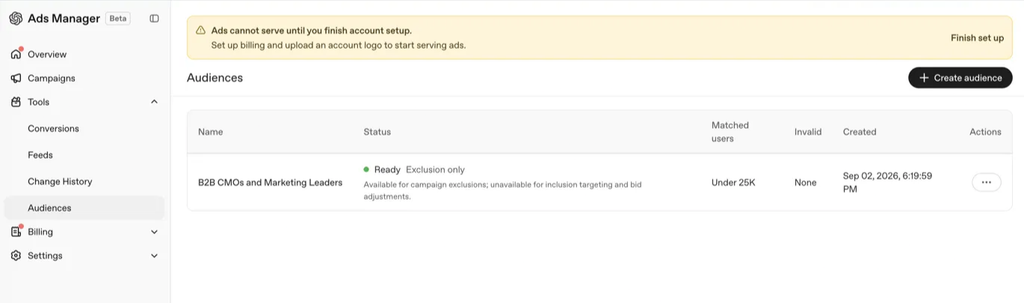
I created an empty audience called “B2B CMOs and Marketing Leaders” with no file (the dialog marks the file optional). Ads Manager reported it as Ready, Exclusion only, Under 25K. The name is just a label.
LinkedIn lets advertisers reach cohorts far smaller than 25,000 (300 to be exact). OpenAI’s floor works as a privacy threshold as much as a targeting one, which keeps free tier ChatGPT users from being singled out by narrow lists.
Note that custom audiences still aren’t supported for campaigns targeting the EEA or Switzerland, where personalised ads aren’t available, even though self-service ads now run in those markets.
So a German advertiser can buy ChatGPT ads this week but can’t suppress existing customers or bid up a CRM list. If you’re in the UK, you have a slight advantage.
What ChatGPT ads cost against Meta ads and TikTok
ChatGPT ads pricing starts at £15 per day, and with a 2x daily ceiling and a 7x weekly ceiling, the smallest possible ad spend costs about £105 per week. (UK users, check carefully: you’ll be defaulted to a £50/day budget). Minimum campaign budget in ChatGPT Ads is £75 (about $100).

In comparison, Meta’s minimum for impression-based ad sets is 1 USD a day (they encourage you to spend more), while TikTok requires more than $50 at the campaign level and $20 per ad group. So ChatGPT’s minimum spend is 15 times Meta’s and less than TikTok’s.
Of course, a paid media platform’s practical minimum runs above its floor; just because the minimum CPC is £0.01 doesn’t mean you’ll see much traction at that rate (also competition). Still, the floor indicates which brands OpenAI is courting with ChatGPT ads; it’s not yet the £5/day social media advertiser.
The inversion of expertise
Meta, Google, and LinkedIn built ad platforms that took years to learn, then bolted generative AI onto them. OpenAI has done the reverse: taken an AI chatbot and bolted on ads, with the artificial intelligence drafting the campaign, creative, and bid before the advertiser touches a field.
The barrier to running paid ads has moved from expertise to budget.
There are fewer settings than Google Ads, no keyword lists, no interest graphs, and no lookalikes; only conversation and intent, and I found it more pleasant to use than Meta’s Ads Manager.
Since this week there’s also a ChatGPT Ads Manager plugin that runs inside ChatGPT or Codex. You describe a website or paste a brief, and it drafts ready-to-launch ads, creates variants, edits campaigns, troubleshoots delivery, and reviews performance. It previews each change and asks for confirmation before applying it. So you never have to open Ads Manager at all.
Of course, as with any digital advertising platform, always check and change the defaults if needed. They’re almost never set in your favour.
Will Google Gemini and Claude follow?
The other AI platforms are decidedly on the fence or strongly against ads in AI conversations.
Google’s Gemini app currently has no ads. In December, Google’s ads VP said there were “no current plans” to change that; by the April earnings call, chief business officer Philipp Schindler said a format that works in AI Mode “would transfer successfully to Gemini app.”
Google is testing conversational AI formats in AI Mode and already runs ads in AI Overviews on Google Search, and that business means it doesn’t need Gemini revenue yet. When Gemini ads arrive, expect a mature Google ad targeting stack.
Anthropic published the opposite position on 4 February: Claude will remain ad-free, with no sponsored content beside conversations and no advertiser influence on responses. The essay argues that ad incentives, once introduced, expand over time and erode user trust.
Anthropic’s revenue comes from enterprise and API customers, which makes the pledge cheaper to keep. They even made a whole bunch of funny ads trolling ChatGPT Ads, so there’s that.
Which advertisers should test ChatGPT Ads today?
Performance marketers, agency PPC leads, B2B SaaS founders and content marketing leaders.
If you’re weighing ChatGPT ads fit for business results, give it a go if you or your users are in any of the eligible countries, your buyers hold a free or ChatGPT Go account, you can install a pixel, and £105 a week is a tolerable test (roughly £420/mo, or $565/mo at today’s exchange rates).
Ecommerce brands with a product catalogue get an SFTP feed tool, a multi-product carousel unit, and card-level impressions and clicks reported separately from billable impressions since 20 August. Pairing that with an agentic integration like SM Agent Kit for WordPress might help (#shamelessplug). Brands with large CRM lists get campaign-level exclusion and ad-group bid multipliers.
If you’re in a restricted category like financial services or health, you might face certain restrictions on running personalized ads. OpenAI also disallows gambling and crypto under its ad policies.
Other reasons to eschew ChatGPT Ads for now might include: needing keyword-level control over intent, an effective audience under 25,000 matched users, or if your buyers live on Plus and Enterprise plans.
And as always, if you need help, get in touch.
About the author
Mo Shehu, PhD is a practitioner and researcher of generative AI systems and agentic commerce. Earlier in his career, he managed social media and influencer marketing across eight P&G brands, including Always, Olay, Pampers, and Vaseline, with monthly budgets above $430,000 and a combined reach of over 10 million. He holds a PhD in Informatics focused on social media analytics.