
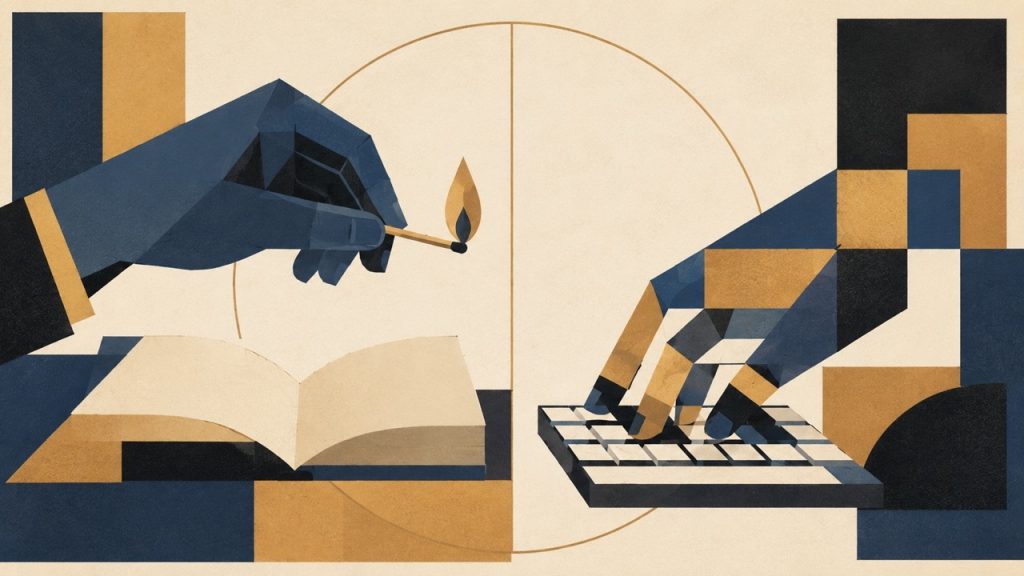

I get why people want you to write; because it’s good for you, because it focuses thoughts, because the first sentence is usually rubbish and the seventh is often better, because you learn cadence and structure and argument through repetition, because there are things you don’t know you believe until you try to explain them, because spending an afternoon wrestling a stubborn idea into words can leave you with a stronger brain; but none of this explains why we’ve decided that the physical production of every word, one keystroke at a time, must now serve as a test of whether a thought is human.
It’s daft.
It takes one useful method of thinking and promotes it into the only respectable one. It confuses the exercise with the outcome, the labour with the intelligence, and asks whether someone typed every word themselves when it should ask whether they had something useful to say, whether they understood it, whether they made the important decisions, whether they checked the claims, and whether they can defend the finished work.
A person can type 3,000 words by hand and have no thought pass through their head beyond the need to finish before lunch. Another can dictate an idea, argue with a language model for an hour, reject six drafts, rearrange the whole piece, rewrite half of it, and publish something they understand down to the final comma. Under our emerging rules of literary customs inspection, the writing police see the first person as a human writer and the second as a suspicious package.
Fire
This feels like the sort of argument that must’ve appeared whenever humans discovered a powerful enough tool. I’ve always thought of AI as fire, which means I can easily imagine some early band of homo erectus becoming completely unbearable about the possibilities, waking up every morning with another idea for what to burn, cook, harden, heat, or illuminate, while another band watched from a neighbouring cave with growing alarm.
The second band would’ve had concerns. Cooked meat would weaken our naturally provided jaws. Warm fires would encourage young people to stay awake after sunset. Heating food would disturb the delicate flora of the ancestral belly. Artificial warmth would make the body dependent on external technology. Weapons hardened in flame would deskill the traditional sharpened-stick industry. Before long, nobody would remember the honourable craft of chewing raw antelope.
Some people would’ve been burned, sure. Someone would’ve certainly set fire to the wrong patch of grass and spent the next morning explaining it was unintended. One band would’ve attacked another with fire, but the defenders would’ve also had fire, which levelled the playing field. The dangers would’ve been obvious, and the pyros would’ve needed rules, better tools, and a growing respect for fire’s dangers.
What they wouldn’t have done is conclude the existence of danger made warmth illegitimate.
We can see the absurdity because we live on the other side of that transformation. We know fire didn’t diminish humanity by relieving our jaws of some work. It expanded what humans could build (and eat), where they could live, and how long they could remain alive. The abilities we lost or used less often paled in comparison to what we gained.
Yet here we are in 2026, standing before another technology that can help millions of people explain, translate, calculate, code, study, design and create, and an influential part of the response has been to develop increasingly elaborate ways to prove that nobody received too much help.
The calculator was accused of weakening arithmetic. Search engines and maps were accused of weakening memory. Spellcheck was accused of weakening spelling. Photography was accused of weakening painting. Recorded music, sampling, digital illustration, coding frameworks, and predictive text have all spent some portion of their existence accused of allowing people to bypass the proper work. Eventually the tool becomes ordinary and the outrage moves on.
Privilege
The demand for proof of human writing is worse because it assumes a particular kind of human body.
Its model writer has two working hands, ten obedient fingers, good vision, fluent spelling, enough muscular control to operate a keyboard, and a mind that can comfortably convert thought into polished prose through sustained typing. Anyone outside that model enters the conversation already under suspicion, because we’ve defined assistance as contamination.
Stephen Hawking couldn’t produce his later work through ordinary speech or typing. He worked with developers on a computerised communication system and voice synthesiser, using technology to carry thought from his mind into the world. Nobody looks at his work on black holes, cosmology, or quantum gravity and wonders whether the machine should receive half the credit. Nobody reads A Brief History of Time and dismisses the ideas because the author couldn’t press each key with his own fingers. We understand, without needing a committee, that technology transmitted Hawking’s thought rather than replacing him.
Now consider the MouthPad, a custom-fitted mouthpiece that lets someone control a phone, tablet, or computer through tongue, head, and breath movements. A quadriplegic person might scroll with their tongue, select letters through a mouth gesture, use predictive text to complete words, dictate other sections, and ask software to turn compressed input into fluent sentences. At what point does the work cease to belong to them?
Is a finger human but a tongue artificial? Is a tongue acceptable until predictive text completes the word? Is ordinary autocomplete permitted because we’ve stopped noticing it, while a language model is forbidden because we can still see the machinery? How many letters must a person select before the sentence qualifies for citizenship?
The questions get ridiculous because authorship has never lived in your tendons.
It lives in intention, judgment, and responsibility. Who wanted to say this? Who supplied the ideas? Who chose what stayed and what disappeared? Who recognised when the machine produced nonsense? Who accepted the consequences of publication? Who can explain the argument without asking Claude to attend the meeting on their behalf?
Those questions work whether someone writes with a pen, dictates to a secretary, types with their feet, moves a cursor with their tongue, uses eye tracking, relies on a screen reader, accepts a predicted phrase, or asks an LLM to rewrite a paragraph. They also expose people who generate pages they haven’t read, publish claims they don’t understand, and hide behind automation when challenged.
That’s the premise we need: not human vs. machine, but judgment vs. surrender.
Ownership
Some places still need unaided work. Schools need to know whether student scan form arguments. An employer wants reassurance someone can perform when their tools fail. A novelist might decide that writing every sentence is part of the art. Fine. Define the ability being tested, create the appropriate conditions, and assess it.
But turning unaided typing into a general certificate of humanity is technologically backward and needlessly exclusionary. It protects one old production method by pretending the method is the mind itself.
I don’t care whether you wrote every word with your bare hands. I care whether the thought is yours, whether you exercised judgment, whether the result deserves my attention, and whether you’ll stand behind it.
Your fingers were never the author.