


Three years after “prompt engineer” became a sought-after job title, the role has nearly disappeared from job boards, and a blunter claim has replaced it: prompt engineering is dead.
The reality is more layered. The casual form of the skill, typing clever instructions into AI chatbots, has faded as any modern language model can read intent on its own.
The production form, designing the full set of instructions a generative AI tool reads before it answers, has become the foundation of a broader discipline.
Whether prompt engineering still counts depends entirely on which form you mean.
Where the term ‘prompt engineering’ came from
Prompt engineering grew out of natural language processing, but it became a popular skill because of a limitation. When OpenAI released GPT-3 in 2020 and ChatGPT in late 2022, the underlying language model was powerful but brittle. The same AI prompt, phrased two ways, produced very different results.
Practitioners learned that prepending “You are an expert” or appending “Let’s think step by step” could improve an answer, and a catalogue of named prompting techniques grew around those discoveries:
- few-shot examples
- chain-of-thought prompting
- prompt chaining
- generated knowledge prompting
- directional stimulus prompting
- meta prompting
- reusable prompt functions
- automated systems like the Automatic Prompt Engineer that wrote and tested prompts on their own
This was inference-time work, distinct from prompt tuning, a machine learning method that adjusts a model’s parameters during training. Prompt engineering changed the input; it never touched the model.
Why demand for the prompt engineer fell
The job-title boom was brief. Indeed’s data, cited by the company’s VP of AI, shows searches for prompt engineer roles rising from two per million US searches in January 2023 to 144 per million by April 2023, then settling at 20 to 30 per million.
In the UK the role barely registered, appearing in 0.046% of permanent vacancies in the six months to June 2026, though the few roles that did ask for it carried a median salary of £50,000.
Two forces drove the decline. First, newer artificial intelligence systems read intent well enough that the old phrasing tricks stopped adding much, so a clear, specific instruction now produces an effective prompt without ceremony.
Second, polished prompts spread everywhere. Every AI tool, template, open repository, and prompt engineering guide now ships with prompts already written, so most users select from a menu rather than designing prompts themselves.
How the prompt engineering discipline got renamed
The skill didn’t disappear; it acquired a new label over a few weeks in mid-2025.
| Date | Who | What they said |
| Early 2023 | Riley Goodside | First used the phrase “context engineering” |
| June 19, 2025 | Tobi Lütke, Shopify CEO | Preferred “context engineering” over prompt engineering |
| June 25, 2025 | Andrej Karpathy, ex-OpenAI | Called it the careful work of filling the context window correctly |
| June 27, 2025 | Simon Willison | Endorsed the reframing publicly |
| Sept 29, 2025 | Anthropic | Published a formal definition alongside Claude Sonnet 4.5 |
The term predated the moment, but the mid-2025 endorsements made it canonical. Lütke framed context engineering as providing all the context a task needs for the model to solve it. Karpathy described people associating prompts with short instructions, while production systems depend on the wider context state.
What prompt engineering still covers
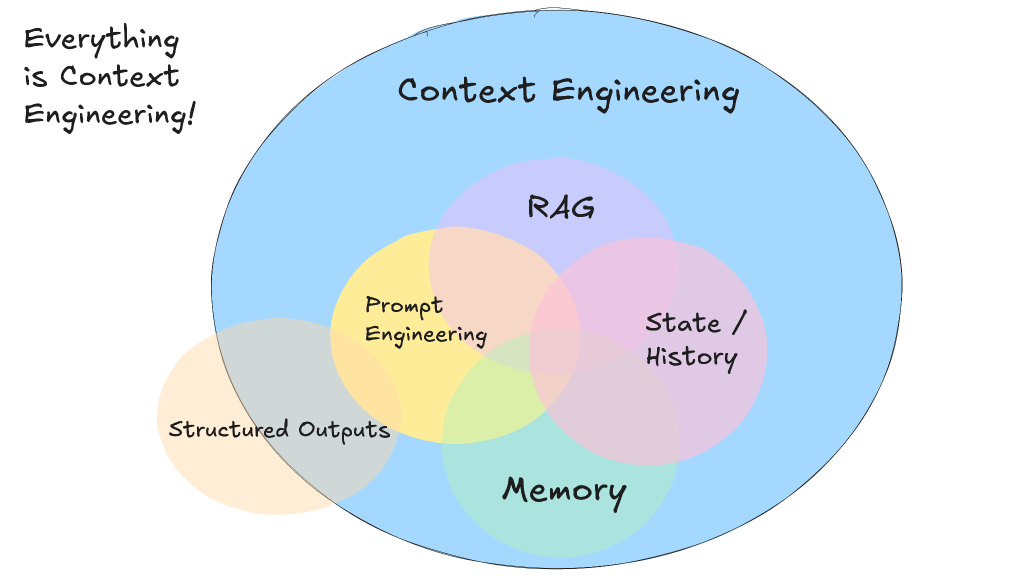
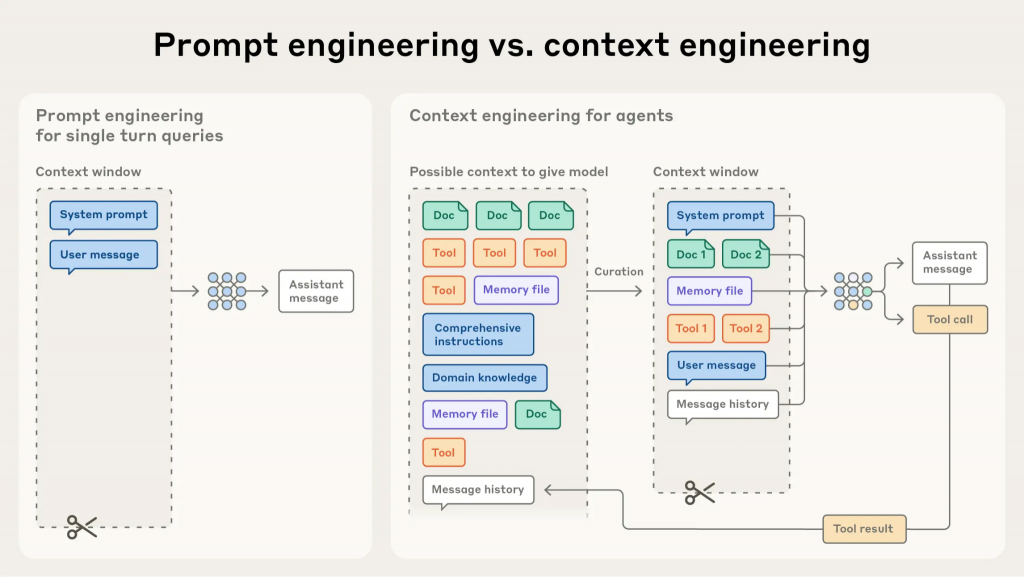
Anthropic’s definition frames context engineering as the strategies for curating the optimal set of tokens during model inference, including everything that reaches the context window beyond the prompt itself.
Under that framing, prompt engineering becomes one component of context engineering rather than its rival.
The prompt still does real work; it just shares the context window with retrieved documents (RAG), conversation history, tool outputs, and user data.
In production, the discipline covers several distinct jobs. System prompt design fixes the model’s persona, constraints, tone, and refusal rules (we define this in n8n workflows, for example).
Few-shot prompting supplies worked examples so the model returns the desired output format reliably.
Chain-of-thought prompting structures a complex task into ordered steps, which still improves LLM reasoning in multi-step agent workflows where one error compounds downstream. Prompt chaining feeds each output into the next call.
A security layer addresses adversarial prompting: prompt injection, where malicious instructions hidden in external content hijack behaviour, and prompt leaking, where a user extracts the hidden system prompt.
Across all of these, the surrounding context governs the AI output as much as the prompt does.
| Casual prompting | Production prompt design | |
| Who does it | Everyday users | AI engineers and practitioners |
| Main concern | Getting a useful answer | Reliable, safe, scalable behaviour |
| Typical methods | Clear phrasing, a little context | System prompts, few-shot examples, prompt chaining, RAG |
| Status in 2026 | Commoditised | Core skill |
What to focus on instead
The practical question is which layer of the stack you work at. For everyday use of AI chatbots and other AI tools, the engineering has thinned to three habits: be clear, be specific, give context.
For anyone building with a generative AI system, the work is context engineering, and the prompting techniques carry straight into it.
Anthropic’s context engineering guide is the most authoritative starting point, and the same post doubles as a deep dive into context rot, the documented decline in recall as the token count climbs.
The skill also keeps spreading because gen AI use is now mainstream across business, which means more people writing instructions for models that handle reasoning, text generation, information extraction, and generating code.
Whether a company calls the training prompt engineering technique, AI prompt engineering, or context design, the underlying approach is the same: clear instruction, structured reasoning, output specification, and context management. Published best practices now converge on those same habits.
Newer reasoning LLMs reduce the need for some older prompt engineering techniques, yet they raise the value of knowing what to put in front of the model and what to leave out.
Build these skills properly with my Claude training, covering everything from system prompt design to a context engineering deep dive.