


A whole industry has decided that the way artificial intelligence retrieves and cites content is so novel, so unprecedented, and so structurally different from everything that came before it that it demands a new discipline, a new budget line, a new set of specialists, and a new suite of software tools.
That industry is wrong, and the brands paying for its services deserve a clearer account of what they’re buying.
Answer Engine Optimization, or AEO, is the practice of structuring content so that a generative AI platform selects it as a cited source when generating answers. It’s sometimes called Generative Engine Optimization (GEO).
Its proponents will tell you it’s an evolution of search engine optimization (SEO), that it requires distinct strategy and investment, and that brands not implementing it right now are already losing market share to competitors who are.
Few of those claims survive examination.
Worse, Google itself dismisses most of those claims.
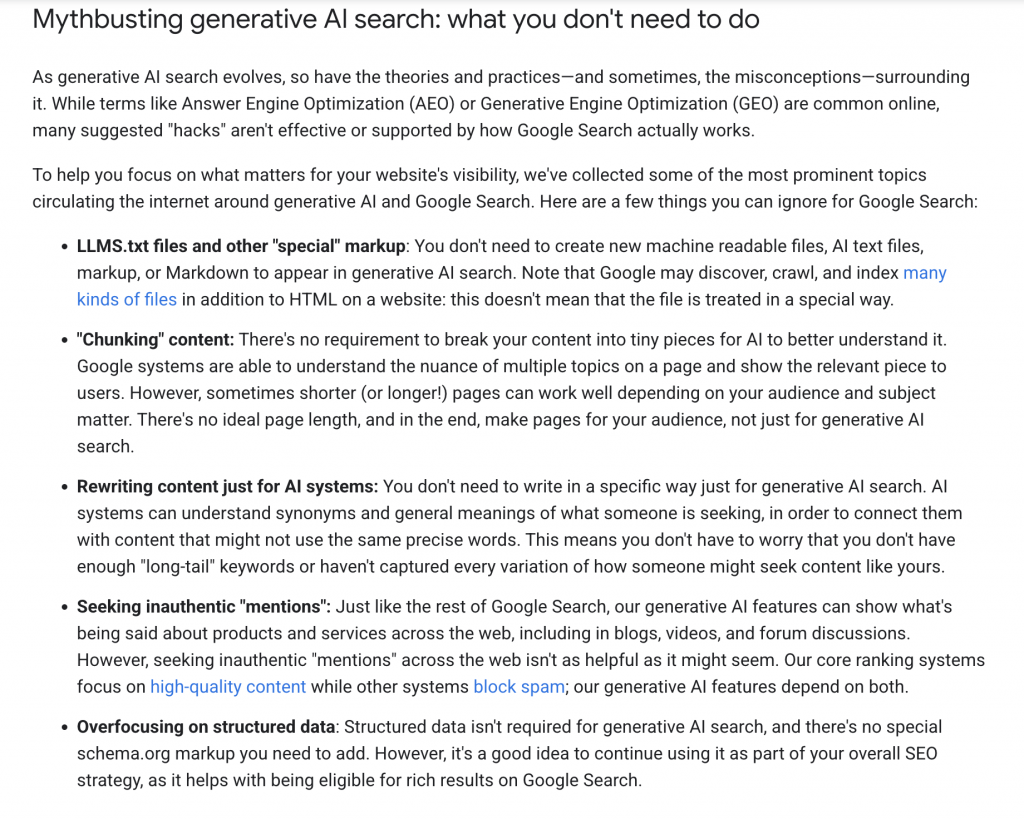
What most AEO strategies describe is good content practice, renamed and repackaged as AI visibility. But most digital marketing teams don’t understand AI well enough to push back.
What AI SEO claims
The AEO discourse rests on a simple premise: AI systems retrieve and cite content differently from how search engines rank it, so you need a different optimisation strategy.
The tactical recommendations that follow from this premise include:
- Restructuring content into Q&A format
- Adding schema markup
- Creating dedicated FAQ blocks
- Shortening paragraphs (“chunking”)
- Placing a concise answer at the top of every section
- Appearing on specific platforms (Wikipedia, Reddit, LinkedIn)
- Monitoring your “share of answer” from AI assistants
- Tracking “citation quality scores,” and
- Buying purpose-built AI visibility tools to measure all of the above
Every single one of those recommendations either describes standard SEO and content best practice from the last fifteen years, contains a factual misunderstanding of how large language models work, or both.
Strip the new terminology from AEO success guides and you’re left with:
- Write clearly
- Earn authority
- Keep content current, and
- Make sure search engines (and AI assistants) can crawl your site
That’s the same brief every competent content professional has been working from since before GPT-2.
Statistical fear as a marketing strategy
AEO’s commercial viability depends on urgency. If the situation isn’t critical, there’s no justification for new spend.
So the discourse opens with statistics designed to alarm.
You’ll find that over 60% of Google searches now end without a click, proving the era of organic traffic is over.
You’ll find Gartner predicting a 50% drop in organic traffic by 2028, a 25% decline in traditional search volume by 2026, and various other figures that collectively suggest the floor is about to give way beneath any brand that fails to act immediately.
These figures deserve more scrutiny.
A significant portion of zero-click searches are navigational queries—people typing “YouTube” or “BBC Weather” into a search bar—and knowledge panel lookups for sports scores, currency conversions, and dictionary definitions.
These queries say nothing about user intent and were never going to generate commercially meaningful website traffic.
They didn’t represent lost opportunity before AI existed, and they don’t represent lost opportunity now.
An AI response providing a direct answer is probably better for everyone involved.
The zero-click trend also predates Google’s AI Overview by nearly a decade. Google has returned direct answers in search results since 2012.
Presenting a pre-existing and largely benign trend as evidence of a new crisis requiring new investment is a textbook consulting move.
The Gartner projections are cited with the reverence usually reserved for peer-reviewed research, which they’re not.
Gartner publishes the Hype Cycle, a model that explicitly documents how new technologies attract peak inflated expectations before settling into realistic productivity.
Citing a Gartner forecast at the peak of AI hype, without noting Gartner’s own methodological caution, is selective reading at best.
Google’s actual reported search volume has continued to grow. AI tools appear to be expanding total information-seeking behaviour rather than replacing search. People who use ChatGPT also still use Google.
The substitution thesis is far weaker in real data than it is in the prediction models that AEO vendors cite to justify their existence.
Then there’s the ROI claim: that B2B companies implementing effective AEO strategies achieve 287–415% return within 90–120 days.
This fantastic figure has no named source, no methodology, no sample size, and no definition of what “AEO implementation” constitutes.
It has no explanation of how ROI was isolated from concurrent SEO, paid media, or sales activity happening in the same period.
It’s a marketing number produced to justify a service fee.
Any practitioner who cites it without a primary source is either credulous or dishonest.
The AEO myth at the centre of everything
The most consequential misunderstanding in AEO discourse concerns how language models actually process text.
The claim, stated explicitly in guides from HubSpot, Frase, Zensciences, and dozens of agency blogs, is that you must restructure your content into discrete, scannable chunks so AI can extract and cite it.
Long, dense paragraphs, the story goes, cause AI systems to skip your content. Q&A format, short sections, and clear answer blocks are the formats AI prefers.
Such AI comprehension is wrong on a basic level.
Large language models are not skimmers. An AI Answer engine isn’t running your content through the same cognitive shortcut a tired human reader uses when scanning a webpage at midnight.
The entire foundational achievement of transformer-based language models is the ability to derive meaning from long, complex, structurally inconsistent, and ambiguous natural language text.
AI models are trained on academic papers, legal documents, forum arguments, novels, technical documentation, and code—none of which are formatted in Q&A blocks, and all of which AI systems parse with full comprehension.
Chunking does exist in AI systems. It’s a retrieval strategy used in some Retrieval-Augmented Generation (RAG) pipeline implementations, where long documents are split into smaller segments to make vector search more efficient.
But that chunking happens at the system level, applied automatically to whatever text the retriever fetches from the web. You don’t control it, and your formatting choices don’t influence it.
A well-written paragraph in the body of a 3,000-word essay can be chunked, retrieved, and cited just as readily as a two-sentence answer block under a question-formatted heading.
What short paragraphs, Q&A sections, and clear answer placement actually do is improve readability for human readers. That’s a legitimate and important goal.
Content that’s easier to read is content that people engage with, share, and reference—which builds the domain authority that AI systems, like search engines before them, use to decide what’s trustworthy enough to cite.
The human reader is still the mechanism. The AI engine is just another downstream beneficiary of already good content.
The AEO industry has taken a set of genuine UX and readability recommendations, misattributed them to AI parsing requirements, and sold them as a new technical discipline.
Schema, llms.txt, and other structural theatre
Guides across the industry recommend adding FAQ schema, Article schema, and speakable schema to improve AI citation rates.
They recommend creating an llms.txt file to guide AI crawlers. They recommend entity optimization—consistent brand naming across all platforms—as a new AEO requirement.
Regarding schema, structured data markup improves how Google renders content in traditional search results. Rich results, FAQ dropdowns, and breadcrumb trails are all schema-dependent features in Google’s own systems.
There’s legitimate evidence for this in the context of Google’s indexing infrastructure.
But there’s no consistent, conclusive evidence that ChatGPT, Claude, Perplexity, or Gemini prioritise pages with schema markup when selecting citations.
These systems process retrieved text and other content. They don’t necessarily parse your JSON-LD and conclude your content is more trustworthy because of it.
Schema is worth implementing for traditional SEO. Selling it as an LLM citation strategy misrepresents how AI answer engines work.
Regarding llms.txt, this is a proposed convention, not a standard, that some retrieval-based AI systems may eventually choose to respect. It has zero relevance to the training data of existing language models, which was collected before your llms.txt file existed.
For live-retrieval systems like Perplexity’s crawler, there’s a limited analogy to robots.txt. Marketing it as a meaningful strategic lever for most brands is overselling a file that many AI answer engines currently ignore.
Regarding entity optimisation, consistent brand representation across platforms—same name, same description, same category—has been a local SEO and Google Knowledge Graph recommendation since • at least • 2013.
Framing it as a new AEO requirement implies it wasn’t already standard, which is false.
It was valid advice before AEO existed, and it’ll remain valid after AEO has been reabsorbed into general SEO practice.
The authority claims: digital PR with a new name
A recurring recommendation in AEO guides is that brands must build presence on the specific platforms AI systems cite most frequently: Wikipedia, Reddit, YouTube, Quora, and LinkedIn.
Some guides describe this as “AEO real estate.” The implication is that strategic placement on these platforms is a distinct AEO tactic.
It’s digital PR. It’s been a core component of SEO strategy since at least 2013.
The mechanism is identical: earn mentions and links on credible external domains to build your own domain’s perceived authority.
The platforms may have changed as the web has changed, but the strategy hasn’t.
There’s also a practical problem with the Reddit and Quora recommendations specifically. These communities have moderation systems specifically designed to remove branded content (or the obvious AI generated answer) that doesn’t contribute genuine value.
A brand that attempts to manufacture forum presence as an AEO play will likely have that content removed, and may accumulate a negative reputation in communities that have long memories.
Authentic community participation builds real authority over time. It always has. Treating it as a tactical AEO lever fundamentally misunderstands why forums have any authority in the first place.
The attribution fiction behind AEO content strategy
The AEO industry has produced a set of AI-driven search metrics that sound rigorous: Share of Answer (the percentage of AI prompts where your brand appears), citation quality score, answer freshness lag, prompt visibility.
It has produced tools to measure them—Profound, Scout by Yext, HubSpot AEO—and case studies showing these metrics trending upward.
What it hasn’t produced is a validated causal chain between these metrics and business outcomes.
AI systems don’t always pass UTM parameters (as of writing, ChatGPT does; Claude and Gemini don’t).
Traffic referred from ChatGPT and similar tools often appears as direct traffic in analytics platforms unless you set up filters by session source.
AI Overviews within Google may contribute to more impressions but not more clicks or traffic.
AI-powered answers are also highly consistent: your brand may appear three times during a search, four during the next, and twice during another run.
You may appear first in one AI tool, and third in a different tool. You may sometimes not appear in AI-powered results on different days.
In short, it’s all highly probabilistic.
The attribution chain from “AI cited us” to “customer purchased” is almost entirely invisible under standard analytics infrastructure. Agencies that claim to measure AEO ROI are measuring proxies and presenting them as outcomes—a practice that looks confident on a client dashboard and falls apart under any serious interrogation.
The conversion rate claim also needs examination. AI-referred visitors are reported to convert at dramatically higher rates than standard organic visitors. The more plausible explanation for this is selection bias, not a property of AEO.
Someone who clicks through from an AI answer (whether from a Google AI Overview or AI tool) has already received a synthesised summary of your content and your offer, and arrives with narrower intent. That’s a property of later-stage buyers, who would have converted at higher rates regardless of how they arrived.
Attribution research in digital marketing has consistently • found that last-click and first-click models overstate the importance of the channel at the moment of conversion.
There’s no reason to assume AI referral breaks that pattern.
| AEO metric | What it claims to measure | What it actually measures | Business outcome relationship |
| Share of Answer | Brand prominence in AI results | Prompt-specific brand mentions | Unvalidated |
| Citation quality score | Authority of sources citing you | Vendor-defined score | No standard definition |
| Answer freshness lag | Recency of AI citation | Assumed content-to-citation delay | Unmeasurable |
| Prompt visibility | Frequency of brand in AI answers | Inconsistent across sessions | Unvalidated |
| AI referral traffic | Visits from AI platforms | Partial (much is attributed elsewhere) | Directional at best |
The urgency machinery
The commercial logic of AEO depends entirely on fear.
The discourse tells you that only 20% of organisations have begun implementing AEO, creating a first-mover advantage.
That competitors are already appearing in AI answers where you aren’t, costing you deals at the research stage.
That brands not adopting AEO now risk becoming invisible as AI search matures.
But the first-mover claim is built on a false premise.
If AEO is substantially identical to good content and SEO practice—and the evidence strongly suggests it is—then every organisation that has invested in quality content, strong domain authority, and technical SEO hygiene has already implemented AEO. They just didn’t use the label.
The 20% figure measures self-reported adoption of a term, not adoption of the underlying practices. Renaming existing investment as “not AEO” to manufacture a gap is a sales technique.
Yes, competitors may appear in AI answers where you don’t. Whether that’s costing specific deals is entirely unverified.
The causal chain—competitor cited in ChatGPT, buyer excludes you from shortlist, lost deal—is not a fact. They may have simply conducted a better demo or discovery call than you.
What the situation actually requires
Don’t get me wrong—AI Overviews do suppress click-through rates from traditional search results. AI-assisted research is a growing part of the B2B buyer journey. These are genuine changes that warrant a response.
But they don’t warrant a new discipline with a separate budget and team.
It just warrants a renewed commitment to the content quality standards serious practitioners have always advocated, paired with a realistic understanding of what AI systems actually favour.
| What AEO guides recommend | What already existed | What actually drives AI citation |
| Q&A formatted content | Journalism, UX writing, featured snippet optimisation | Content accuracy and authority |
| Schema markup | SEO technical best practice since 2011 | Domain authority and topical depth |
| Expert bylines and author credentials | E-E-A-T guidelines (Google, 2015) | Named sourcing and expertise signals |
| Brand presence on authoritative platforms | Digital PR | Genuine authority on credible domains |
| Content freshness | Content maintenance best practice | Recency, for retrieval-augmented systems |
| Clear, structured answers | Plain language guidelines, content design | Clarity and specificity |
| Consistent entity representation | Local SEO, Knowledge Graph optimisation | Brand governance and disambiguation |
Content marketing in the AI age calls for the same, simple strategy from forever ago:
- Produce accurate, specific, well-sourced content that demonstrates genuine expertise.
- Maintain a technically clean site that crawlers can access and index.
- Build authority through credible external mentions, not manufactured platform presence.
- Update content when it’s factually outdated, not on an arbitrary weekly schedule designed to satisfy a vendor’s “freshness lag” metric.
- Write for the human reader first—because the human reader is still the mechanism through which you build authority, establish trust, and elicit purchases.
AI systems are good at identifying useful content. They’re also good at identifying content masquerading as useful, produced by teams chasing a metric they don’t fully understand, to satisfy a discipline that exists because someone needed to sell an AEO tool.
The real first-mover advantage in AI search isn’t in tracking your Share of Answer, but in producing content authoritative enough that it doesn’t matter.